


Key Takeaways for Eichler Homeowners
- Architectural Sensitivity: Eichler post-and-beam ceilings lack attic cavities, making roof deck integrity directly responsible for interior protection and thermal comfort.
- Storm Risk: Atmospheric river storms brought by El Niño drop heavy rain over consecutive days, creating standing water that breaks down glued seams on traditional roofs.
- Weight Advantage: Closed-cell spray polyurethane foam weighs roughly 60 pounds per 100 square feet, removing up to 90% of the weight of old tar and gravel roofs.
- Drainage Correction: Foam application allows technicians to slope low spots, building positive drainage toward perimeter scuppers and internal drains.
- Long-Term Protection: Backed by 40+ years of local experience, Armstrong Foam Roofing installs systems with 15-year renewable warranties and 0% APR financing for 12 months.
Eichler flat roof El Niño preparation should start with four checks:
- whether water can leave the roof,
- whether any leak has a traceable source,
- whether skylights and other penetrations are sealed, and
- what condition the roofing and deck are in.
Only then should you choose repairs or a system. A foam application or coating cannot cure wet materials or failed drainage.
You probably want a roof that handles winter rain and a roofline that still looks like the house its architects drew. Both are reachable when decisions happen in the right order. In this guide, we will discuss what to check, what to leave to professionals, where spray polyurethane foam (SPF) fits, and what to ask before signing anything.
What El Niño Means for Bay Area Roof Preparation
El Niño is a periodic warming of Pacific surface water near the equator, one phase of a cycle called the El Niño Southern Oscillation (ENSO). The National Weather Service office in Sacramento says these events arrive irregularly, roughly every two to seven years. It also reports little correlation between most ENSO patterns and precipitation in Northern California, with Southern California responding more strongly (NWS Sacramento, “ENSO Information for Northern California”). El Niño is a climate pattern, not a forecast for your street, and it is not the same thing as an atmospheric river.
Because outcomes vary, rain readiness matters in every ENSO phase. A drain that clogs in a modest storm will clog in a large one, and prolonged or repeated rain simply gives existing flaws more time to show themselves. This article stays evergreen; for a current outlook, check the issuing agency’s latest forecast and its publication date.
Architectural Vulnerabilities of Bay Area Eichler Homes
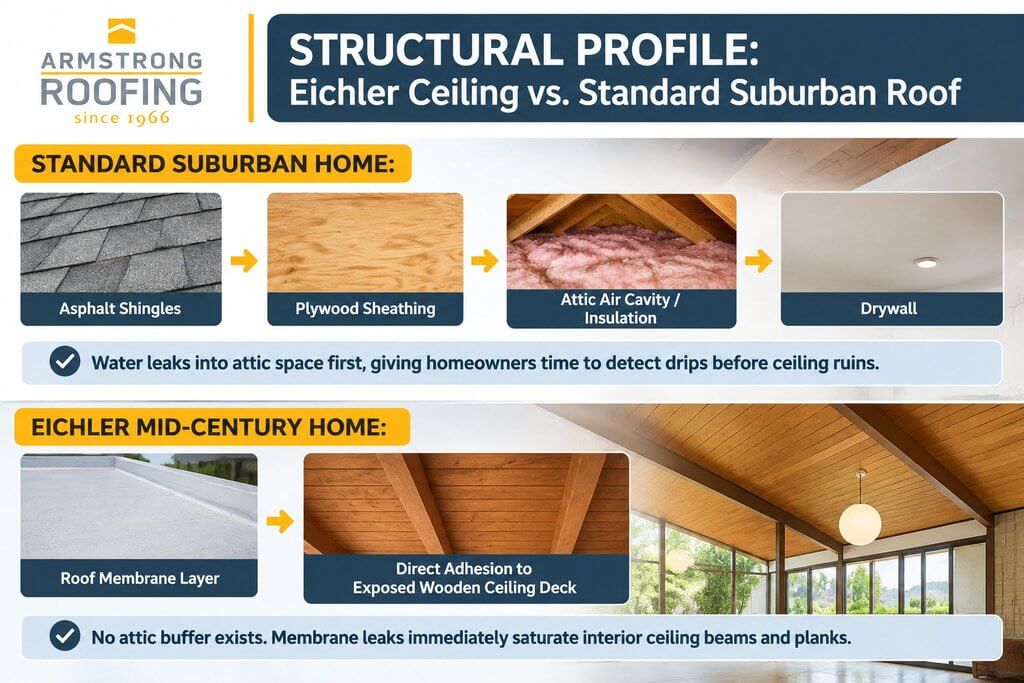
Mid-century modern residences built by developer Joseph Eichler between 1949 and 1974 represent a distinct architectural tradition in Northern California. Concentrated across Palo Alto, San Jose, Sunnyvale, San Mateo, Walnut Creek, and Marin County, these homes feature open floor plans, soaring glass walls, radiant-heated concrete slabs, and exposed post-and-beam ceiling structures. Architects like A. Quincy Jones, Frederick Emmons, and Claude Oakland discarded traditional pitched attics in favor of low-sloped or completely flat roof profiles.
This design strategy creates expansive interior spaces, but it imposes strict engineering demands on the roof assembly. Without a conventional attic cavity to hide ductwork or fiberglass insulation, the tongue-and-groove wooden ceiling boards double as the structural roof deck. Any moisture that breaches the top weather membrane passes directly into the finished ceiling lumber below, causing unsightly wood stains, dry rot, and structural deterioration.
Proper Eichler flat roof El Niño preparation requires an understanding of how these structural elements interact with regional weather. Because these homes feature thin fascia lines and delicate architectural proportions, installing heavy conventional roofing materials or bulky insulation panels can alter original sightlines and overload aged wood beams. Homeowners must select a waterproofing material that protects against storm water without compromising the historic character of their residence.
Eichler Flat Roof El Niño Preparation: A Homeowner Checklist
Sound Eichler flat roof El Niño preparation separates what you can observe safely from what needs a trained person on the roof. Work through the three timing windows below, then use the table below to decide who should act.
Before the rainy season
- From the ground or a window, look for debris near visible outlets, stained fascia, and sagging gutters.
- Photograph the roof edge and ceilings now as a baseline.
- Request a professional assessment while the weather is dry.
Before a forecast storm
- Confirm that visible gutters and downspout outlets at ground level run freely.
- Note any existing ceiling stains so you can tell new from old.
After rainfall, when observations are safe
- Look from the ground or indoors for overflow, standing water at the edges, and fresh stains.
- Call a professional if the same spot shows up twice.
Think of drainage as a complete route: roof surface, then drain or scupper (an opening that lets water exit), then gutter or leader (the downspout), then discharge location. Clearing one visible outlet may not fix a blockage downstream, a roof that lacks adequate slope, or a deck that has sagged. A trade guideline on evaluating roofs for SPF (SPFA-138) tells inspectors to examine gutters, downspouts, evidence of ponding, and evidence of structural movement together.
What to Observe and Who Should Act
| Observation | Possible Significance | Safe Homeowner Action | Professional Follow-Up |
| Debris near drainage outlets | Reduced outflow; water may back up | Note it from the ground; do not climb | Clear outlets and check the downstream route |
| Repeated standing water | Slope, blockage, or deck movement | Photograph from a safe vantage after rain | Locate the low point and determine the cause |
| Interior staining | Water has reached the assembly, possibly far from the entry point | Mark the edge of the stain and date it | Trace the source; test for trapped moisture |
| Worn or exposed foam | Protective coating may have thinned | Photograph; avoid walking on the roof | Evaluate coating condition and repair needs |
| Deteriorated flashing | Gaps at joints and edges | Note location from the ground | Repair or replace with compatible materials |
| Loose rooftop equipment supports | Movement can open seals and punctures | Record visible tilt or looseness | Re-secure and re-flash the support |
No single row proves a diagnosis. A stain can come from a skylight, a drain, or plumbing, so treat each symptom as a prompt for investigation.
Safety first: Do not walk on wet roofs, enter unsafe areas, cut roof blisters, drill drainage holes, or apply incompatible patching materials. Leave elevated cleaning and roof work to qualified personnel.
If several rows in the table above sound familiar, you can request a free consultation and estimate from Armstrong Foam Roofing at (855) 777-1234.
Check Skylights, Vents, and Other Roof Penetrations
A penetration is anything that passes through the roof surface: a skylight curb, plumbing vent, pipe, conduit, equipment support, or solar attachment. Flashing is the material that seals the joint where the roof meets those objects or a vertical surface such as a wall. Many leaks start at these joints.
Review each category on your roof:
- Skylight curbs: the raised frames, and the joint where roof meets frame.
- Plumbing vents and mechanical equipment: movement from wind or service visits can strain seals.
- Solar attachments, where present: each attachment is a hole that must stay sealed.
- Roof-mounted pipes or conduits: mounted too low, they can trap water against the surface.
- Horizontal-to-vertical connections: flashing at walls must bridge two surfaces that move differently.
Movement, aging sealants, inaccessible details, and poorly placed supports all deserve attention. A tube of sealant spread over a failing joint is a surface patch. A durable repair removes the failed detail and installs compatible flashing, and “compatible” matters because materials that fight the roof system can fail early. SPFA’s roofing guide (SPFA-104) says conduits should be relocated or raised above the finished roof surface, and it warns against covering drainage weep holes at skylights and walls. Do not bury pipes or conduits in foam. Ask instead about access, clearances, and drainage around each item.
Comparative Analysis of Roofing Technologies for Low-Slope Decks
Selecting the correct roofing material for a low-slope or flat roof requires evaluating structural weight, seam integrity, thermal performance, and long-term maintenance needs. Homeowners often choose between three primary roofing categories: traditional Built-Up Roofing (BUR), single-ply membranes (TPO or PVC), and Spray Polyurethane Foam (SPF).
Built-Up Roofing (Tar and Gravel)
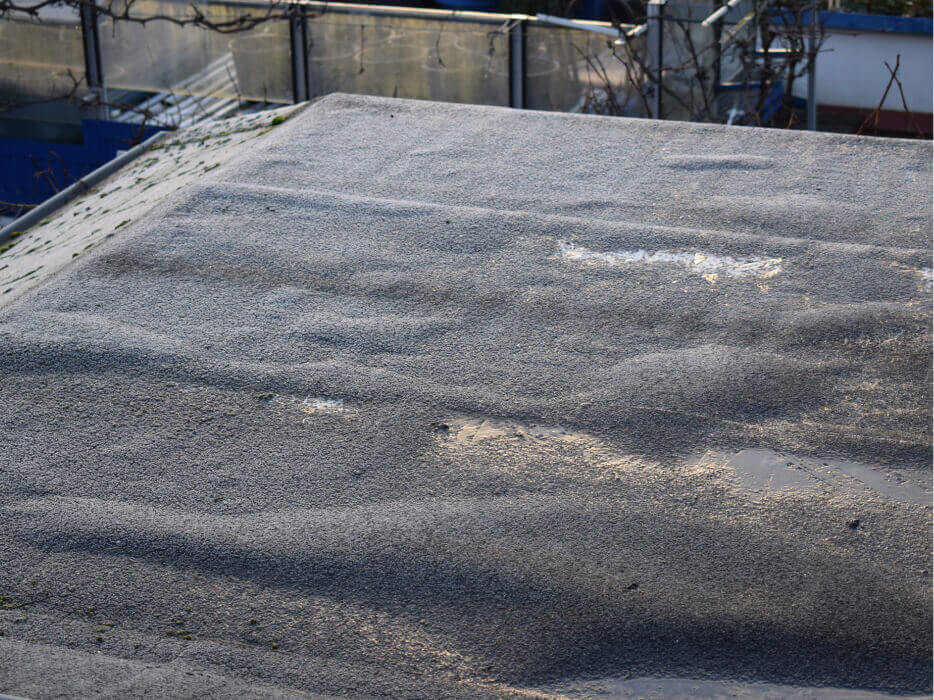
Built-up roofs consist of multiple layers of asphalt-saturated felt paper fused together with hot asphalt, capped with a top layer of loose gravel. While common on original 1950s homes, tar and gravel systems present major disadvantages for Eichler structures. A standard BUR installation weighs roughly 600 pounds per 100 square feet. Over decades, this excessive weight causes wooden ceiling beams to bow downward, creating permanent low spots that collect rainwater. In addition, finding leaks on a gravel roof proves extremely difficult, as water often enters at one point and travels along internal felt layers before emerging inside the home.
Single-Ply Membranes (TPO and PVC)
Single-ply membranes involve rolling out rubberized or plastic sheets across the roof deck and welding the edges together with hot air or chemical glues. While lighter than gravel, single-ply systems rely entirely on seam integrity. A standard residential flat roof contains hundreds of linear feet of field seams and corner splices. Thermal expansion and contraction during sharp Bay Area temperature swings put continuous stress on these glued seams. Once a seam splits or pulls apart, storm water enters freely beneath the membrane.
Closed-Cell Spray Polyurethane Foam (SPF)
Spray polyurethane foam technology applies as a liquid chemical mixture that expands 30 times its volume within seconds, hardening into a rigid, closed-cell insulation barrier. Because it bonds directly to the prepared roof deck, SPF forms a solid, unbroken layer across the entire building envelope. Weighing just 60 pounds per 100 square feet, foam removes up to 90% of the weight burden associated with old tar and gravel systems. With zero seams, zero lap joints, and zero mechanical fasteners, spray foam eliminates the primary failure points common to conventional roofing systems. Thorough Eichler flat roof El Niño preparation often centers on replacing seamed systems with this continuous insulation barrier.
| System Characteristic | Traditional Tar & Gravel (BUR) | Single-Ply Membrane (TPO/PVC) | Closed-Cell Spray Foam (SPF) |
| System Weight | ~600 lbs per 100 sq. ft. | ~40 to 80 lbs per 100 sq. ft. | ~60 lbs per 100 sq. ft. |
| Seam Structure | Overlapped felt seams under gravel | Welded or glued field seams every 6-10 ft | 100% Monolithic (Zero seams or joints) |
| Ponding Water Performance | Poor; asphalt degrades under standing water | Fair; seams can fail under continuous pooling | Excellent; closed-cell foam is fully waterproof |
| Thermal Insulation (R-Value) | Minimal (R-1 to R-2 total system) | Requires separate rigid foam boards | R-6.6 per inch (Highest rated system) |
| Structural Impact | Causes ceiling deflection and beam sag | Moderate structural load | Ultra-lightweight; relieves beam stress |
| Wind Uplift Resistance | Gravel blows off in storm winds | Vulnerable to air intrusion under sheets | Bonds directly to deck; resists hurricane winds |
| Expected Service Life | 10 to 15 years before tear-off | 15 to 20 years before replacement | 50+ years or even a lifetime with periodic elastomeric recoating |
Engineering Positive Slope and Eliminating Ponding Water
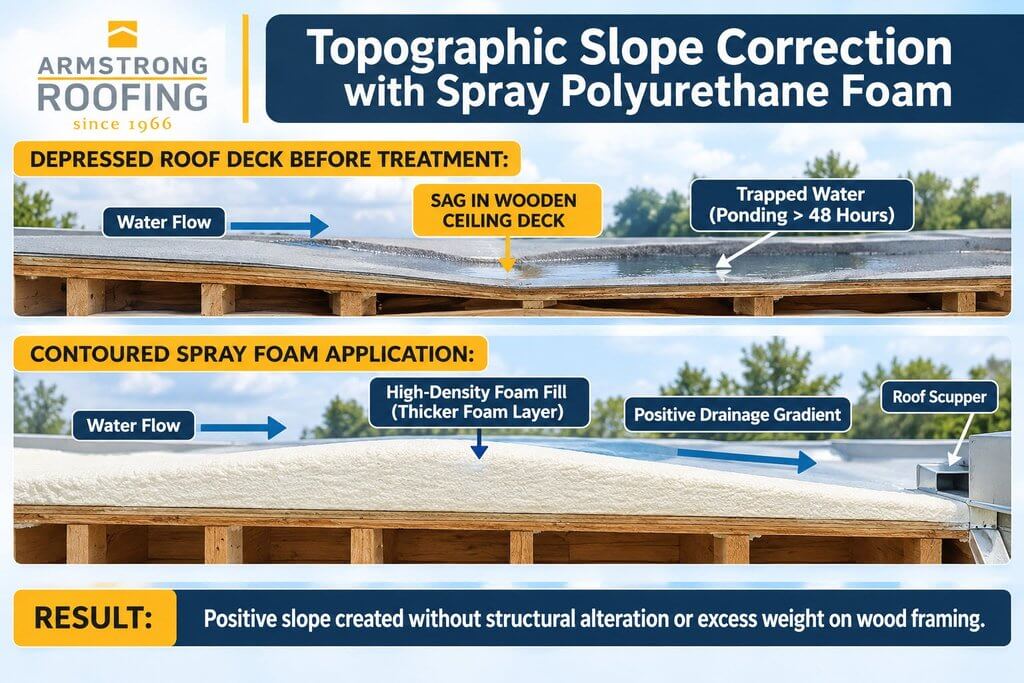
A fundamental rule of roof engineering dictates that water must move off the building deck as quickly as possible. When water remains on a roof surface for longer than 48 hours, it poses a direct threat to building materials. Correcting low spots and slope deficiencies forms the foundation of successful Eichler flat roof El Niño preparation.
Because original tongue-and-groove roof boards settle over time, flat roofs often develop shallow depressions near center points or between support beams. Correcting these depressions with traditional roofing materials requires building heavy wooden crickets or cutting rigid insulation boards into tapered slopes. These methods add labor costs, increase structural weight, and fail to conform smoothly to irregular roof decks.
Spray polyurethane foam offers a fluid engineering solution for uneven roof decks. During application, trained technicians adjust the spray pass depth, building up foam thickness in depressed areas and tapering the material smoothly toward perimeter scuppers, gutters, and internal drains. By custom-contouring the roof topography, the application eliminates birdbaths and establishes a positive slope that directs rainwater off the roof.
Sealing Critical Penetrations and Envelope Detailing
Addressing roof penetrations represents a critical step in complete Eichler flat roof El Niño preparation. An average Eichler home features numerous roof openings, including center atria, plastic dome skylights, plumbing vent stacks, furnace flues, electrical conduit feeds, and solar panel mounting brackets.
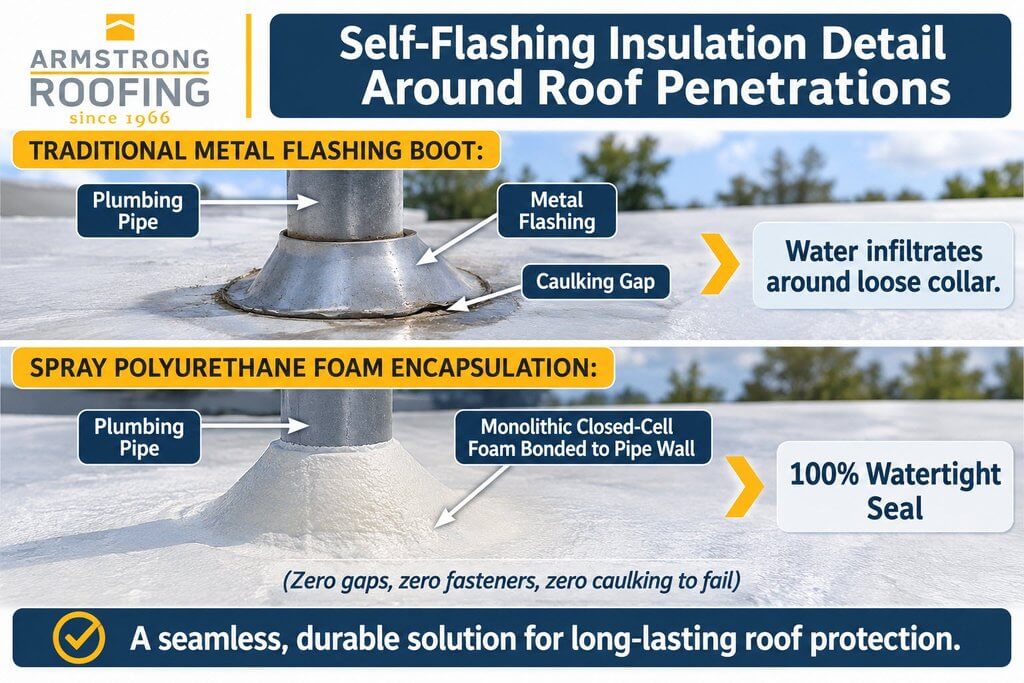
On traditional roofs, technicians seal penetrations using metal flashing boots, rubber collars, and petroleum-based caulking. Over time, sunlight breaks down these sealants, while thermal movement pulls metal boots away from surrounding pipes. During driven atmospheric river downpours, rain running down vertical pipe surfaces slips beneath loose metal boots and drips directly into living areas.
Spray polyurethane foam provides a self-flashing application. As the liquid material expands, it flows into microscopic cracks around pipes, conduit lines, and skylight curbs, bonding securely to copper, PVC, metal, and wood. This creates a solid, continuous boot that rises vertically up the penetration wall. Because the waterproofing material forms a single unified layer with the roof membrane, there are no metal joints to rust or caulking joints to split.
Thermal Performance and Radiant Ceiling Integration
While winter storm readiness focuses primarily on stopping water, thermal insulation plays a critical role in building preservation and indoor comfort. Eichler homes are famous for their radiant heating systems, which circulate hot water through copper pipes embedded inside concrete floor slabs. However, because these residences lack traditional attics and feature uninsulated roof decks, indoor heat rapidly escapes upward through the ceiling during cold winter months. High-performance insulation is therefore an essential component of Eichler flat roof El Niño preparation.
Installing high-density closed-cell spray polyurethane foam on the exterior roof deck addresses this thermal loss directly. Closed-cell foam delivers an insulation rating of R-6.6 per inch, providing exceptional thermal resistance in a thin profile. Applying 1.5 to 2 inches of foam creates a continuous thermal blanket over the wooden ceiling decking.

This thermal barrier stops thermal bridging, a process where outdoor cold transfers through roof fasteners and wooden beams into interior living spaces. By preventing warm indoor air from escaping through ceiling boards, the insulation reduces the workload on radiant heating boilers and cuts home heating and cooling energy costs by up to 40%.
To protect the foam core from solar degradation, technicians cover the cured insulation with a dual-coat elastomeric UV protective coating embedded with reflective ceramic granules. This white reflective surface forms a certified cool roof that reflects up to 85% of solar energy away from the home. During warm summer months, the reflective top coat keeps roof deck surface temperatures up to 50°F cooler, maintaining comfortable indoor temperatures year-round.
Step-by-Step Pre-Storm Readiness Checklist for Homeowners
Use this step-by-step checklist to guide your Eichler flat roof El Niño preparation before winter storms arrive:
- [ ] Clean Drainage Pathways: Clear all pine needles, leaves, and organic debris from perimeter scuppers, roof drains, downspouts, and valley collection points.
- [ ] Inspect Drainage Flow: Pour a bucket of water near low spots to verify that water drains completely within 24 hours without forming persistent pools.
- [ ] Examine Skylight Seals: Inspect the rubber gaskets and acrylic domes on skylights for cracks, foggy glass, or dried sealant around perimeter curbs.
- [ ] Check Roof Penetrations: Examine plumbing vent pipes, chimney flues, and solar mounting brackets for cracked mastic, loose metal boots, or visible gaps.
- [ ] Audit Exterior Trim and Fascia: Check metal edge flashing strips along the roof margin to ensure they remain tightly fastened to wood fascia boards.
- [ ] Inspect Surface Coating Condition: On existing foam roofs, check the elastomeric top coat for surface scratches, bird damage, or thin areas where yellow foam is exposed to sunlight.
- [ ] Trim Overhanging Tree Branches: Prune back heavy oak and pine branches extending over the roof to prevent mechanical punctures and reduce leaf accumulation.
Frequently Asked Questions (FAQ)
How often does a spray foam roof require maintenance?
A professionally installed spray polyurethane foam roof requires minimal ongoing maintenance. Homeowners should inspect drains and clear organic debris twice annually, typically in spring and fall. The underlying foam core lasts indefinitely, while the protective elastomeric top coat should be renewed with a fresh layer every 15 to 20 years to maintain complete UV protection.
Can spray foam roofing be installed directly over an existing flat roof?
In many cases, yes. If the existing roof substrate is structurally sound, dry, and securely anchored, spray foam can be applied directly over old built-up or single-ply roofs after thorough surface cleaning and preparation. This eliminates the expense, noise, and environmental landfill waste of a complete roof tear-off.
Will a foam roof alter the visual profile of my Eichler home?
No. Because closed-cell foam provides high thermal resistance per inch (R-6.6), a standard 1.5-inch application delivers superior insulation without creating a thick, bulky roof edge. The low profile preserves original mid-century fascia lines and clean architectural proportions.
How does spray foam handle heavy foot traffic from solar installers or technicians?
Closed-cell roofing foam uses a high-density 3LB formula engineered to withstand routine foot traffic. Technicians can walk on the surface safely during HVAC maintenance or solar panel servicing. For areas expecting heavy traffic, contractors can apply additional coating layers and broadcast ceramic granules to enhance impact resistance.
Selecting a Qualified Contractor: Why Armstrong Foam Roofing Leads the Bay Area
Installing a spray polyurethane foam roof is a specialized technical discipline that requires chemical precision, high-pressure application equipment, and deep familiarity with local building codes. Unlike traditional roofing materials that arrive pre-manufactured in rolls, a spray foam membrane is manufactured directly on your roof surface during application. Selecting an experienced, licensed contractor remains the most important step for successful Eichler flat roof El Niño preparation.

Armstrong Foam Roofing has served property owners across the San Francisco Bay Area since 1966. As a local, family-owned business with over 40 years of dedicated spray foam experience, Armstrong has completed more residential spray foam installations than any other contractor in the United States.
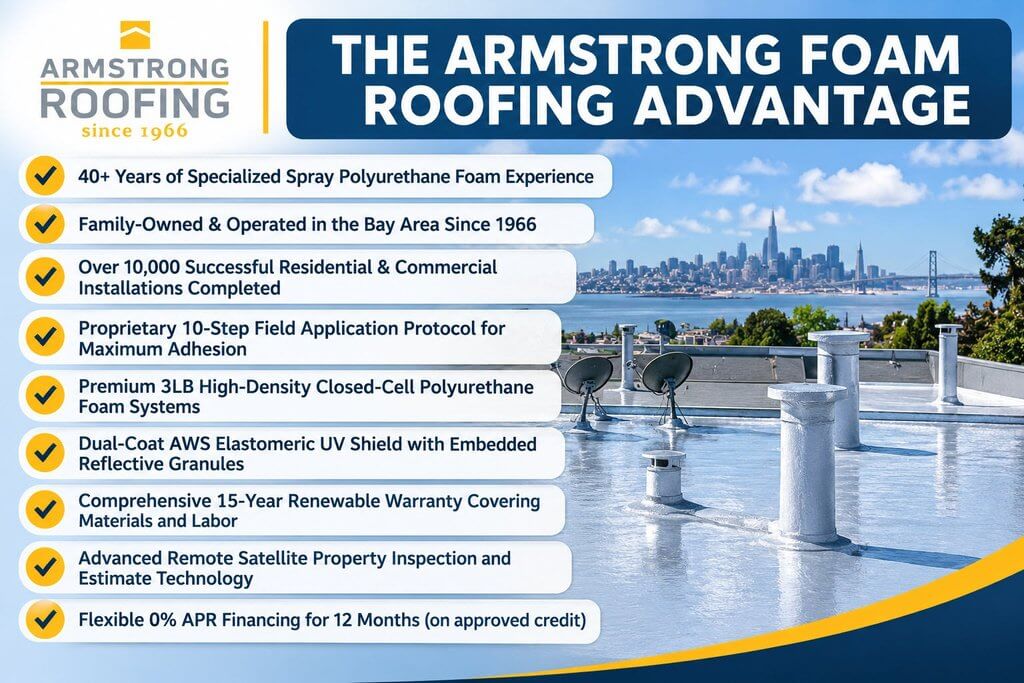
Armstrong’s 10-step installation protocol leaves no room for error. Every project begins with a satellite property survey, followed by thorough surface preparation, substrate repairs, precision foam application, and dual-layer UV coating installation. Armstrong backs every project with an industry-leading 15-year warranty covering both materials and installation craftsmanship, giving homeowners complete confidence during severe weather seasons.
El Niño Protection Plan for Your Eichler Flat Roof
Your Eichler home is a celebrated architectural asset that deserves dependable, long-term weather protection. Relying on aging built-up tar and gravel or seamed single-ply membranes during an intense El Niño season exposes your property to serious risk of water intrusion, interior ceiling damage, and wood rot.
Upgrading to a closed-cell spray polyurethane foam system from Armstrong Foam Roofing resolves flat roof vulnerabilities at their source. By removing structural weight, eliminating lap seams, engineering positive drainage slopes, and delivering thermal insulation, an Armstrong foam roof keeps your residence dry, energy efficient, and comfortable through every storm season.
Do not wait for atmospheric rivers to overflow your gutters and leak into your wooden ceiling beams. Take action on Eichler flat roof El Niño preparation today to safeguard your home.
Schedule Your Free Inspection and Remote Estimate Today
Protect your flat or low-slope roof with Northern California’s trusted foam roofing specialists. Armstrong Foam Roofing serves homeowners and commercial building managers across San Francisco, Oakland, Berkeley, San Jose, Palo Alto, Marin County, the Peninsula, South Bay, East Bay, and Silicon Valley.
Why Contact Armstrong Foam Roofing Today?
- Free Satellite Roof Inspection: Receive a detailed condition assessment and estimate without taking time off work.
- Proven Track Record: Over 40 years of local expertise and thousands of satisfied Eichler homeowners.
- Special Promotion: Take advantage of 0% APR Financing for 12 Months (with approved credit).
Get in Touch:
Call 1-855-777-1234 or schedule a free roof inspection and estimate online.