


Why El Niño and Flat Roofs Deserve Attention
Bay Area winters rarely look like a Midwest blizzard, but they can still punish a flat roof. A string of Pacific storms can drop rain for days, wind pushes moisture sideways into seams and flashing, and one drain packed with leaves can turn a roof into a shallow pond. Add El Niño to the forecast, and many property owners start wondering what it means for the building over their heads.
El Niño can shift storm tracks and raise the odds of a wetter winter in parts of California, though the effect varies by location and by how strong the event turns out to be. Nobody can promise how much rain will fall on your street in Oakland or Palo Alto. What you can control is whether your roof is ready for sustained wet weather. That matters most for El Niño and flat roofs, because low-sloped roofs depend on drains, seams, and coatings to move and block water instead of a steep pitch.
Armstrong Foam Roofing is a family-owned, local spray polyurethane foam (SPF) roofing contractor that has served the Bay Area since 1966, with a focus on flat and low-sloped roofs. In this guide, we explain what El Niño means for flat roofs and the practical steps owners can take before winter.
What El Niño Means for Bay Area Weather
El Niño is a climate pattern in which surface water in the central and eastern tropical Pacific runs warmer than average. That extra heat changes how the atmosphere behaves above it. NOAA explains that these changes can pull the winter jet stream (the fast river of air that steers storms) farther south than usual, and that stronger El Niño events tend to send more Pacific storms toward California and the southern United States.
NOAA research on El Niño and California precipitation shows a higher likelihood of wet conditions in some years, not a guarantee, and the signal is typically more pronounced farther south than in Northern California. The Bay Area sits in a transition zone. Coastal fog, hills, bayside flatlands, and inland valleys can all see different totals from the same storm, so a roof in the Sunset District will not live through the same winter as one in San Jose.
So why prepare at all? Because a normal Bay Area winter already exposes weak spots in an aging flat roof. A cracked coating, loose flashing, or sluggish drain can hold up through a dry year and then fail during a few weeks of steady rain. Treat the El Niño outlook as a good reason to finish the maintenance you might otherwise postpone.
What El Niño does and does not mean for your roof
Does: It can increase the likelihood of wetter winter conditions in parts of California.
Does not: It does not guarantee a specific number of storms, flooding, or roof leaks.
Practical takeaway: Prepare as though the roof will face sustained rain, wind, and drainage stress.
Why flat roofs need proactive attention before winter
A pitched roof lets gravity do most of the work. Rain runs off the surface quickly, and the usual trouble spots are shingles and valleys. A flat or low-sloped roof moves water slowly. It depends on a gentle slope toward drains, scuppers (openings in a parapet wall that let water out), and gutters. When any part of that system slows down, water lingers, and lingering water finds every weakness.
Common vulnerabilities in flat roofs include:
- Ponding water that collects and fails to drain properly.
- Blocked drains that prevent water from flowing off the roof.
- Worn flashing, the metal or membrane that seals joints around walls, curbs, and vents.
- Open seams and cracked coatings that allow moisture to penetrate.
- Punctures caused by foot traffic or rooftop equipment.
- Poor slope that prevents effective drainage.
- Aging built-up roofing, the layered tar-and-gravel systems found on many older Bay Area buildings.
Not every flaw is urgent. Faded color or light surface staining is mostly cosmetic, and a hairline crack in an otherwise sound coating is a maintenance item. Open flashing, soft spots, or standing water that never leaves are different. Those can let moisture reach the insulation and deck, which can lead to reduced insulation performance, deteriorated structure, mold risk, and interior damage.
Roofers see this pattern constantly: by the time a stain shows up on a ceiling, water has usually already traveled through the roof assembly, sometimes several feet from where it got in. That is why you should inspect the roof’s exterior before you see any interior signs.
Flat Roofs vs. Pitched Roofs in Wet Weather
| Factor | Flat or Low-Sloped Roof | Pitched Roof |
| Water movement | Relies heavily on slope, drains, and scuppers | Sheds water down the roof plane |
| Main risk during storms | Ponding, drainage blockage, seam and flashing failure | Missing shingles, wind damage, valley leaks |
| Warning signs | Standing water, bubbles, cracks, stains, debris buildup | Curling or missing shingles, granules in gutters |
| Best preparation | Pre-winter inspection and drainage maintenance | Shingle and flashing inspection |
The Pre-Winter Flat Roof Inspection Checklist
The National Roofing Contractors Association recommends regular, scheduled inspections and maintenance for flat roofs, including a check before the wet season. Use the lists below to understand what a thorough inspection covers and which signs you can spot safely. Stay off the roof yourself. Walking on a flat roof is dangerous, especially when it is damp, and foot traffic can crack coatings or puncture foam and membranes. Leave close-up work to a professional.
What a Professional Should Inspect
- Membrane or foam surface condition
- Coating condition, including chalking, cracking, blistering, thin spots, and exposed foam
- Flashing at parapet walls, curbs, skylights, vents, HVAC supports, and roof edges
- Drains, scuppers, gutters, and downspouts
- Ponding water and low areas
- Seams, penetrations, and earlier repair areas
- Debris, vegetation, sediment, and roof-mounted equipment
- Interior warning signs, such as ceiling stains, musty odors, or damp insulation
Warning Signs That Need Attention Before the Rains
- Ponding water that stays more than 48 hours after rain, weather permitting
- Cracked, peeling, or chalky coating
- Blisters, ridges, soft spots, or exposed foam
- Open flashing or separated metal edges
- Water stains on ceilings or walls
- Overflowing drains or gutters during rain
- Unexplained higher energy bills, which can point to insulation or roof-system problems
You can safely check several of these from the ground, from a window, or from an interior ceiling. If you see two or more, book an inspection instead of waiting for the first storm to confirm your suspicion.
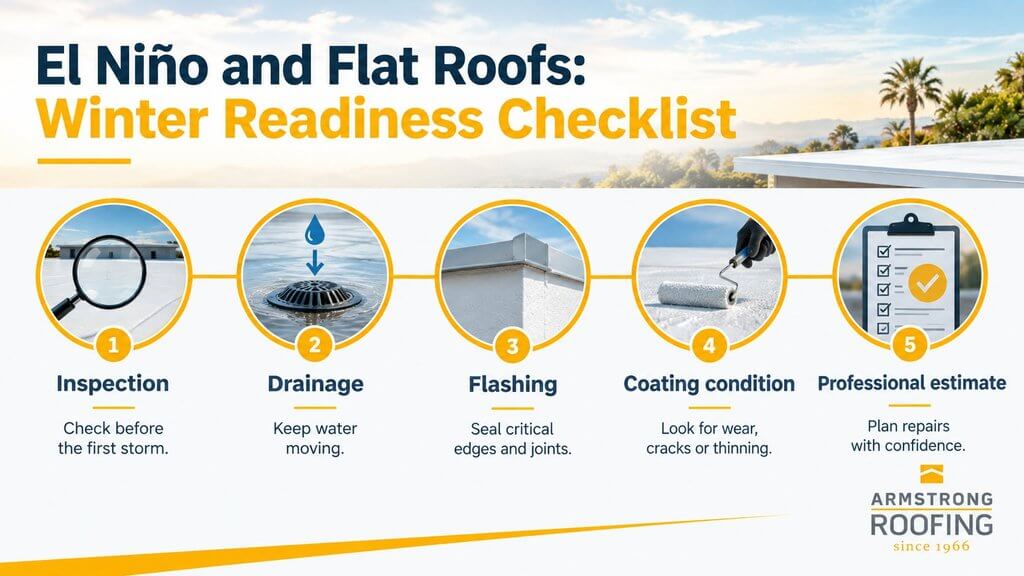
Drainage: The Most Important Winter Step for El Niño and Flat Roofs
If you remember one thing about El Niño and flat roofs, make it this: water that leaves the roof quickly rarely causes trouble, and water that stays usually does.
A well-designed flat roof has a slight slope that guides water toward intentional low points. From there, it exits through internal drains, scuppers, or gutters, and then travels down downspouts and away from the building. Every link matters. A clear drain feeding a clogged downspout still backs up.

Ponding water happens when water cannot leave on schedule. Causes include poor original slope, a blocked drain, settled or compressed insulation, or a sagging deck. A little water after a storm that evaporates the next day is common. Water that sits for days is a concern because it speeds up coating wear, stresses seams, and adds weight. A single inch of water across a roof adds a surprising load, and blocked drains can multiply that.
Picture a commercial building in the East Bay. Leaves and fine sediment gather around a drain over the dry months, and the roof looks fine in September. The first big storm arrives, the strainer clogs, and water spreads across the surface. Pooled water finds a worn seam, and the tenant below sees a stain two days later. A fifteen-minute cleaning would likely have prevented it.
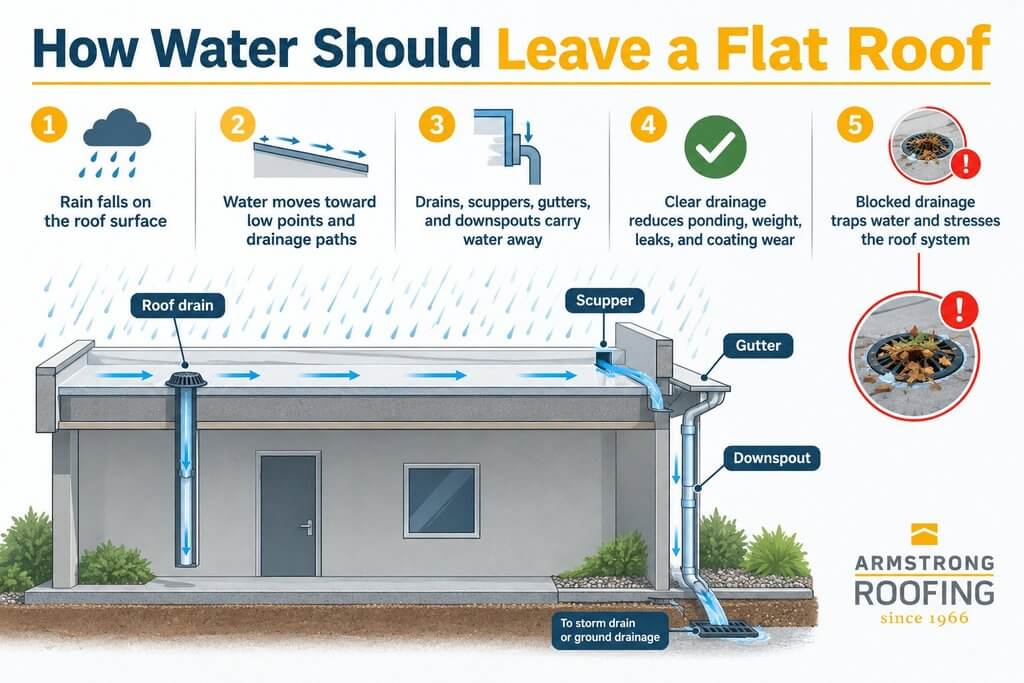
Drainage Warning Signs and Likely Causes
| Warning Sign | Possible Cause | Why It Matters |
| Water remains after rain | Poor slope, blocked drain, compacted insulation, structural sag | Can accelerate membrane and coating wear |
| Debris around drains | Leaves, sediment, roofing granules, vegetation | Can block water flow during heavy rain |
| Overflow at scuppers | Blocked outlet or undersized drainage path | Increases risk of water intrusion |
| Stains near roof edges | Flashing or drainage problem | May indicate water entering the roof assembly |
| Repeated leaks in the same area | Localized drainage, flashing, or membrane failure | Needs professional diagnosis |
Roof Coatings: When Repair, Restoration, or Replacement Makes Sense
On many flat roofs, the coating is the first line of defense. Silicone and elastomeric coatings are liquid-applied layers that cure into a flexible, waterproof surface. They shield the roof from rain, UV exposure, and temperature swings, and reflective versions help keep the building cooler. Silicone tends to handle standing water well, while elastomeric coatings are a common choice for many other conditions. Either way, coatings age. Sun, foot traffic, and repeated wet-dry cycles gradually thin and crack them, so they need periodic evaluation.
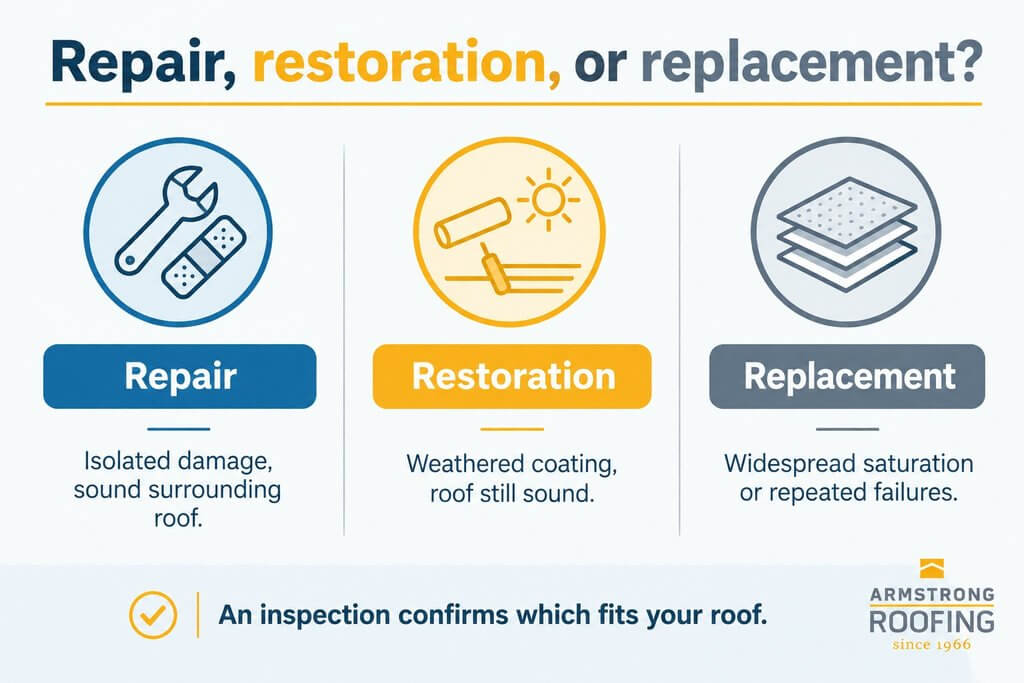
When a Problem Appears, You Generally Have Three Paths:
- Spot repair fits limited, localized damage when the surrounding roof is sound. A single leaking vent or small puncture usually falls here.
- Restoration or recoating fits a roof that is generally sound but has a weathered, thin, or early-deteriorating coating. It adds protection without a full tear-off.
- Replacement fits a roof with widespread saturation, structural problems, repeated failures, or major underlying damage.
Picking the wrong path costs money. A coating over wet insulation traps moisture instead of solving the problem, and replacing a roof that only needed a recoat wastes budget. That is why a professional assessment should come first, ideally including moisture checks and a look at drainage.
SPF works differently from a membrane. The installer sprays two liquid components that react and expand into a rigid foam, creating a seamless layer across the roof. A protective coating then goes on top. The result can provide waterproofing and insulation in a single system, and installers often use it on flat and low-sloped roofs. You can read more about spray polyurethane foam roofing on our site.
Armstrong Foam Roofing evaluates whether foam roof repair, restoration, silicone coating, elastomeric coating, or replacement is the most appropriate fit for the roof in front of us.
Repair, Restoration, or Replacement?
| Option | Best Suited For | Typical Signs | Main Benefit |
| Spot repair | Limited damage in an otherwise sound roof | One leaking penetration, small puncture, isolated flashing issue | Fast, targeted correction |
| Restoration or recoating | Aging but structurally sound roof | Chalking, fading, minor cracks, thin coating, early wear | Adds protection without full tear-off |
| SPF restoration | Suitable flat or low-sloped roof with recoverable conditions | Ponding concerns, insulation needs, weathered existing roof | Can address waterproofing and insulation in one system |
| Replacement | Widespread failure or saturated roof | Repeated leaks, major deterioration, structural concerns | Creates a new long-term roof system |
A Bay Area Winter Roof Preparation Timeline
The best time to inspect and repair a flat roof is before sustained rain, not after the first leak. Contractors also tend to have more scheduling flexibility in late summer and early fall than in the middle of a storm cycle.
Late Summer and Early Fall
- Schedule a professional roof inspection.
- Clear drainage paths and remove debris.
- Repair known leaks and coating defects.
- Review prior repair areas and roof warranties.
Before the First Major Storm
- Confirm drains, scuppers, gutters, and downspouts are clear.
- Address ponding areas and flashing concerns.
- Document roof condition with photos.
- Schedule any needed coating or restoration work.
During and After Winter Storms
- From safe ground level, look for overflow, debris, or visible damage.
- Do not walk on a wet or damaged roof.
- Contact a roofing professional promptly if leaks, ponding, or drainage problems appear.
Photos taken before winter give you a baseline. If a leak shows up in January, you and your roofer can compare conditions instead of guessing what changed.
Why Spray Polyurethane Foam Roofing is Suited to Bay Area Flat Roofs
SPF goes on as a liquid and expands into a continuous foam layer, so a finished roof has no seams for water to work its way into. Seams are where many traditional flat roofs fail first. The foam also insulates, which helps a building stay steadier in temperature, and the system adapts to irregular shapes, curved edges, and the many penetrations found on older Bay Area buildings. It suits low-slope conditions well because installers can build the foam to improve drainage in some cases. You can explore the benefits of an SPF roofing system in more detail.

Spray foam roofing is not automatically the right answer for every roof. Existing moisture, structural condition, drainage, and budget all affect whether foam makes sense, and some roofs need a different approach. Anyone who recommends foam without examining your roof first is guessing.
Armstrong’s process starts with an inspection. We look for the cause of the problem, not just the symptom, and then recommend repair, restoration, coating, or replacement based on what the roof needs. That experience covers residential and commercial flat and low-sloped roofs across the Bay Area, including mid-century and Eichler-style homes.
Many property owners choose Armstrong for a few concrete reasons: local experience since 1966, a specialty in SPF, a full range of repair and restoration options, and free inspections and estimates. If you are comparing contractors, our guide on how to choose a spray foam roofing contractor lists the questions worth asking.
Frequently Asked Questions
How does El Niño affect flat roofs in the Bay Area?
El Niño can raise the likelihood of a wetter winter in parts of California, but it does not guarantee heavy rain in every neighborhood. For flat roofs, the practical impact is more potential for ponding, drain overload, and stress on aging coatings. El Niño and flat roofs is mostly a preparation question, not a prediction.
When should I inspect my flat roof before winter?
Late summer or early fall is ideal, well before sustained rain. That gives you time to repair, clear drainage, and schedule coating work without a rush.
How long can water pond on a flat roof before it becomes a problem?
A common industry benchmark treats water that remains more than 48 hours after rain as ponding worth investigating. Recurring ponding in the same spot deserves a professional look even if it drains eventually.
Is spray foam roofing good for flat roofs?
Yes. SPF provides a seamless surface with insulation and waterproofing in one system, and it suits many flat and low-sloped roofs. Suitability still depends on moisture, structure, drainage, and budget.
How do I know whether my flat roof needs repair or replacement?
Localized damage on an otherwise sound roof usually points to repair. Widespread saturation, repeated leaks, or structural concerns point toward replacement. A professional inspection with moisture assessment settles it.
Does Armstrong Foam Roofing offer free inspections and estimates?
Yes. Armstrong offers free roof inspections and estimates for properties across the Bay Area.
Prepare Your Flat Roof Before the Next Storm
El Niño and flat roofs call for proactive planning because drainage, coatings, flashing, and membrane or foam condition decide how well a roof handles winter rain. You cannot control the forecast, but you can control whether water has a clear path off your roof and whether the surface protecting your building is in good shape.
A pre-winter inspection is also far less disruptive than emergency leak repair. Fixing a flashing gap or recoating a weathered section in dry weather usually costs less than chasing water through wet insulation in January, and it keeps tenants, inventory, and interiors out of harm’s way.
Schedule Your Free Flat Roof Inspection

Armstrong Foam Roofing serves San Francisco, Oakland, Berkeley, San Jose, Palo Alto, Marin County, the Peninsula, East Bay, South Bay, North Bay, Silicon Valley, and the greater Bay Area. Our team will inspect your roof, explain what we find in plain English, and recommend repair, restoration, or replacement only if your roof needs it.
Call 1-855-777-1234 or schedule a free roof inspection and estimate online.