


For many homeowners and facility managers in the San Francisco Bay Area, the roof is a classic example of “out of sight, out of mind” until the first signs of failure appear. Whether it’s a damp spot on a ceiling, the smell of mildew in an attic, or actual pooling water on a warehouse floor, flat roof leaks are more than a nuisance. These are warning signs that the structural integrity of your building is under attack.
In the Bay Area, flat and low-sloped roofs are staples of both iconic residential designs like Eichler homes and expansive commercial facilities. However, our unique climate, characterized by coastal fog, significant temperature fluctuations, and seismic activity, places extreme stress on traditional roofing materials. Since 1966, Armstrong Foam Roofing has been at the forefront of protecting these properties, leveraging over 40 years of specialized experience in Spray Polyurethane Foam (SPF) technology to provide long-term, leak-proof solutions.
The Science of Failure: Why Flat Roofs Leak
Technically, a flat roof should never be entirely flat; it requires a slight slope (ideally around 15°) to allow water to run off toward drains. When a roof is improperly constructed or settles over time, it develops low spots where water accumulates, a phenomenon known as ponding. If water remains on the surface for longer than 72 hours, it begins to degrade traditional roofing materials, leading to rot and eventual infiltration.
The Seam Problem in Traditional Roofing
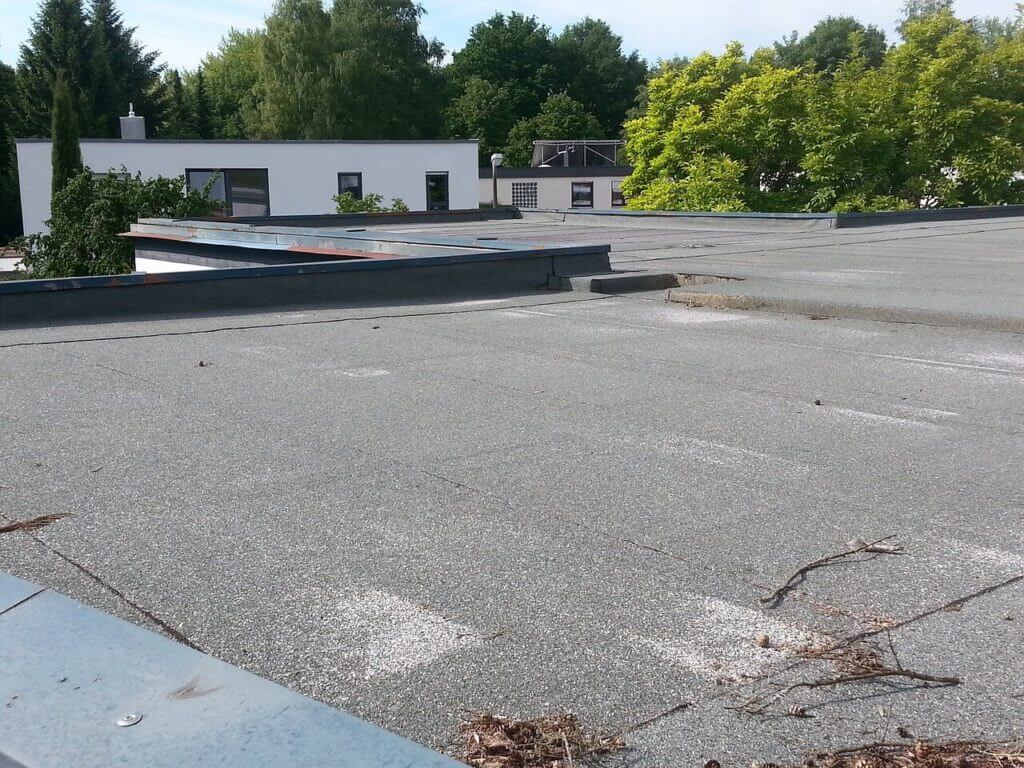
Most traditional low-slope systems, such as Built-Up Roofing (BUR or “tar and gravel”), modified bitumen, or TPO membranes, rely on seams to connect large sheets of material. Even with professional installation, these seams are the weakest link in the system. As the building expands in the summer heat and contracts during cool Bay Area nights, these seams experience constant stress. Eventually, they crack, separate, or pull apart, allowing water and microbes to seep through the layers.
Faulty Flashing and Penetrations
Leaks frequently occur at transitions where the roof meets a wall, chimney, skylight, or HVAC unit. Traditional flashing consists of metal strips designed to bridge these gaps, but because the roof and the structure move at different frequencies, the flashing often loses its seal. On a complex roof with multiple penetrations, each vent and bracket represents a potential entry point for water.
Material Vulnerability Comparison
| Feature | Built-Up Roofing (BUR) | Spray Polyurethane Foam (SPF) |
| Seams | Multiple joints per roof; high failure risk | Monolithic; zero seams |
| Flashing | Requires separate metal seals; prone to lifting | Self-flashing; conforms to all shapes |
| Movement | Rigid layers often crack under stress | Flexible; moves with the building |
| Ponding | Accelerates degradation and rot | Custom-contoured to enhance drainage |
| Weight | ~600 lbs per 100 sq. ft. | ~60 lbs per 100 sq. ft. |
Failure Progression: From Small Drip to Structural Erosion
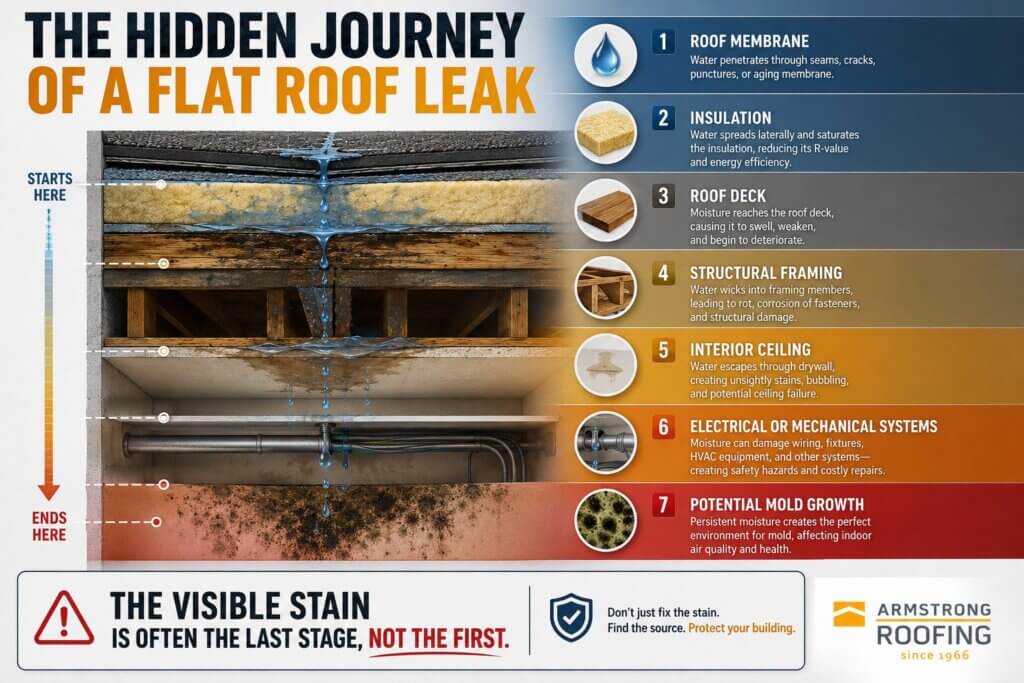
One of the most dangerous aspects of flat roof leaks is that the damage often begins long before a homeowner notices a drip. By the time water is visible inside the living space, it has already soaked through the roofing membrane, saturated the insulation, and potentially begun rotting the wooden roof deck.
Hidden Damage and Bio-Growth
Stagnant water trapped between the layers of a multi-layered BUR system creates a breeding ground for mold and mildew. In the Bay Area’s humid fog, this biological growth can spread rapidly through wall cavities, compromising indoor air quality and destroying interior drywall. Furthermore, moisture-saturated insulation loses its thermal resistance (R-value), leading to skyrocketing energy bills as your HVAC system struggles to maintain a consistent temperature.
The Impact of Seismic Activity
Our region’s seismic zones present a unique challenge. Rigid roofing materials are susceptible to splitting or cracking during minor tremors. These “seismic fractures” may be invisible to the naked eye but are more than large enough to allow water to bypass the primary waterproofing layer.
The Hidden Progression of Water Damage
Understanding what happens after water gets past the membrane is the key to understanding why flat roof leaks deserve prompt attention.
The general sequence tends to follow this pattern, although the exact speed and severity depend on the roof’s design, materials, drainage, ventilation, and how long the moisture has been present:
- Water enters through a weak point like a seam, flashing detail, or penetration.
- Moisture migrates laterally beneath the membrane, often following the path of least resistance across the roof deck rather than dropping straight down.
- Insulation becomes damp or saturated, which reduces its thermal performance and can begin to break down the material itself.
- The roof deck deteriorates, particularly if it is wood or wood-based, as prolonged moisture exposure softens and weakens the structural material.
- Fasteners and metal components corrode, which can further compromise the roof’s structural attachment and drainage hardware.
- Wood framing components may rot in more advanced cases, especially where moisture has been present for an extended period without detection.
- Interior finishes become stained or damaged, which is usually the first sign a property owner actually notices.
- Mold may develop when moisture, an organic food source, and suitable temperatures are all present. The U.S. Environmental Protection Agency notes that it is important to dry water-damaged areas and items within 24 to 48 hours to prevent mold growth, which illustrates how quickly a hidden leak can create conditions favorable to microbial growth well before it is discovered.
This progression is not identical on every building. A well-drained roof with rigid insulation and a concrete deck will generally tolerate a small leak differently than an older wood-frame structure with fiber insulation. Climate, ventilation, and how quickly the leak is identified all influence how far the damage spreads.
To help property owners understand what is potentially at stake, the table below summarizes typical consequences by building component.
| Component | Potential Damage | Relative Cost Impact |
| Roof insulation | Saturation, reduced R-value, mold-supporting conditions | Moderate |
| Roof deck (wood or gypsum) | Softening, delamination, structural weakening | High |
| Fasteners and metal components | Corrosion, reduced holding strength | Moderate |
| Wood framing / structural members | Rot, loss of load-bearing capacity | Very High |
| Interior ceilings and walls | Staining, bubbling paint, drywall failure | Moderate |
| Electrical and mechanical systems | Corrosion, shorts, safety hazards | High to Very High |
| Indoor air quality | Musty odor, potential mold growth | Moderate to High |
Why Delaying Leak Remediation Increases Roof Damage Cost
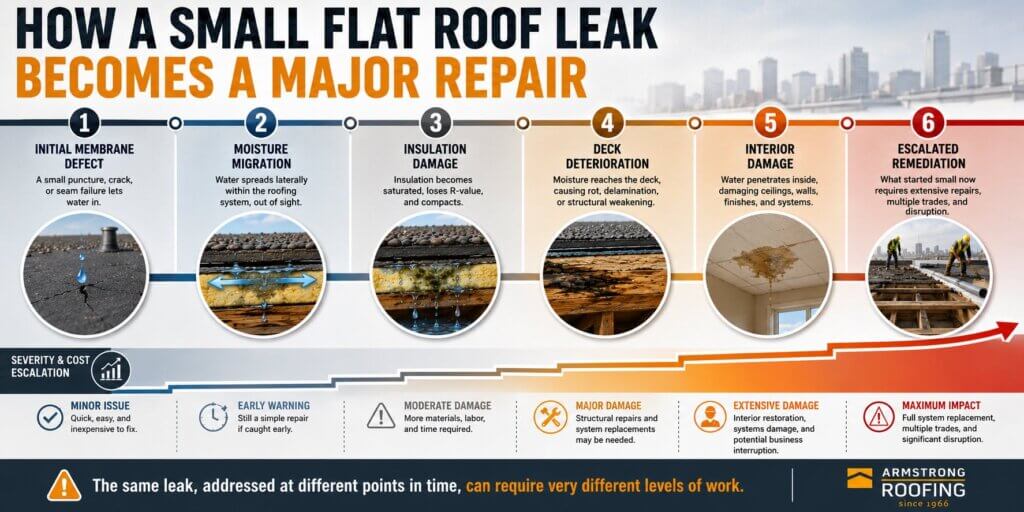
One of the most consistent patterns in roofing is that the cost of correcting a problem grows the longer it goes unaddressed. This is not a scare tactic, it follows directly from how water damage physically spreads through a roofing assembly.
When a leak is caught early, the repair is often limited to a small, localized area: resealing a seam, replacing a section of flashing, or patching a penetration. Materials affected are minimal, and disruption to the property is brief.
When the same leak is allowed to continue for months, the picture changes. Wet insulation may need to be removed and replaced across a much larger area than the original point of entry. The roof deck itself may require partial reconstruction if it has softened or delaminated. Interior ceilings, drywall, and flooring may need repair or replacement. If mold has developed, a mold assessment or remediation process may be required before other repairs can proceed. In commercial buildings, this can also mean addressing electrical or mechanical components that were exposed to moisture.
The table below illustrates, in relative terms, how these two scenarios typically differ. These are general patterns, not guaranteed outcomes or fixed prices for any specific property.
| Issue | Immediate Repair | Delayed Repair |
| Moisture spread | Localized to entry point | Can spread widely beneath the membrane |
| Insulation impact | Minimal, easily replaced section | Larger area saturated, higher material cost |
| Roof deck condition | Typically unaffected | May require partial reconstruction |
| Interior damage | Rare or minor | Ceiling, wall, or flooring repairs often needed |
| Business or household disruption | Low | Moderate to significant |
| Number of repair visits | Usually one | Often multiple, including possible failed patches |
| Relative cost impact | Lower | Moderate to very high |
Delayed leaks also tend to involve multiple failed repair attempts. A patch applied over compromised or still-wet substrate frequently fails again within a season, which means the property owner may pay for repair work more than once before the underlying cause is actually resolved. For commercial properties, this cycle can also mean repeated tenant disruption or, in some cases, temporary closure of affected space.
Commercial Buildings vs. Residential Flat Roofs
Flat roof leaks create different risks depending on whether the building is a home or a commercial property, largely because of differences in scale, occupancy, and what is stored or operating beneath the roof.
Commercial buildings typically have larger roof areas, more rooftop equipment such as HVAC units, exhaust fans, and satellite or solar mounts, and more penetrations overall, each one a potential entry point. Commercial roofs also tend to see more foot traffic during maintenance, which can compress insulation and stress the membrane in specific spots. A leak in a commercial setting can affect inventory, equipment, server rooms, or occupied tenant space, and any required repair work may need to be scheduled around business hours to minimize disruption. Drainage systems on larger commercial roofs are also more complex, often involving multiple interior drains, and a single clogged drain can create a substantial ponding area.
Residential flat roofs, common on mid-century homes throughout the Bay Area, including many Eichler-style homes on the Peninsula and in parts of the South Bay, are generally smaller and simpler, but leaks can still be serious. Many of these homes have exposed wood ceilings or post-and-beam construction directly beneath the roof deck, which means there is often very little concealed attic space to absorb or buffer a leak before it becomes visible indoors. In some cases, radiant heating systems are embedded in the floor slab, which adds another layer of consideration when moisture is present.
In both settings, the underlying lesson is the same: the roof protects everything beneath it, and a defect that seems small from the outside can have an outsized effect on what is happening inside.
How Bay Area Weather Accelerates Roof Problems
Northern California’s climate is often described as mild, and in many ways it is, but “mild” does not mean roofs are spared from stress. The Bay Area’s weather pattern actually combines several conditions that are individually hard on roofing membranes.
Winter brings sustained, sometimes heavy rainfall, often arriving as multi-day atmospheric river events. This is exactly the kind of prolonged wet period that turns a minor seam defect into an active leak, and it is also when ponding water is most likely to accumulate on roofs with drainage issues. Coastal areas, including much of San Francisco, Marin County, and parts of the East Bay closer to the water, experience persistent fog and elevated humidity for much of the year, which keeps roofing materials damp longer than they would be in a drier inland climate. That same moisture, combined with salt-laden coastal air, can accelerate corrosion of metal flashing and fasteners.
Inland and valley areas, including much of the South Bay and Silicon Valley, see more intense summer UV exposure and larger daily temperature swings, which accelerates the thermal expansion and contraction that stresses seams and coatings. Wind-driven rain during winter storms can drive water sideways into vertical flashing details and parapet walls that would otherwise stay dry.

Because these conditions vary somewhat by microclimate. For example, a roof in Oakland’s hills experiences different stress than one in downtown Palo Alto or along the Berkeley waterfront, therefore seasonal inspection timing matters. Many roofing professionals recommend an inspection heading into the rainy season and another after it ends, so that any damage from winter storms is identified and addressed before the next wet season begins. Property owners throughout San Francisco, the East Bay, the North Bay, and the South Bay generally benefit from this same seasonal rhythm, even though the specific stresses on their roof may differ slightly by location.
Warning Signs That Require Immediate Inspection
Several signs indicate that a flat roof should be inspected promptly rather than monitored over time:
- Ceiling stains, even faint or small ones, indicate that water has already reached the interior side of the roof assembly.
- Musty odors often signal moisture is present in a concealed area, even before visible staining appears.
- Bubbling or blistering on the roof surface suggests trapped moisture or vapor beneath the membrane.
- Soft spots on the roof deck, noticeable when walking on the roof, can indicate a saturated or deteriorating deck.
- Visible mold or a suspected microbial growth on interior surfaces near the roofline.
- Peeling interior paint, which often accompanies persistent moisture behind a wall or ceiling surface.
- Cracked, lifted, or separated flashing at walls, curbs, or penetrations.
- Repeated leaks in the same general area, even after a prior repair.
- Ponding water that remains on the roof more than a day or two after rain.
- Rising energy bills without an obvious cause, which can sometimes point to saturated insulation that has lost its thermal effectiveness.
- Damp or discolored insulation, if visible from an interior access point such as an attic hatch.
A brief safety note: Do not walk on a flat roof area that feels soft, spongy, or unstable, and avoid disturbing any suspected mold growth or exposed electrical components near a leak. These conditions should be evaluated by a qualified professional before anyone accesses the area.
Repair, Restoration, or Replacement?
When faced with a leak, property owners must choose between three levels of intervention. Making the wrong choice can lead to a cycle of “patch and repeat” that ultimately costs more than a full replacement.
1. Repair (The Patch Job)
Repairs involve fixing a localized area, such as a single puncture or a loose piece of flashing. While necessary for minor damage, repairs do not address the underlying age or systemic failure of the entire roof. On a traditional BUR roof, water often travels horizontally through the layers, meaning the leak on your ceiling may be 20 feet away from the actual hole on the roof.
2. Restoration (Recoating)
Restoration is a proactive process for roofs that are still structurally sound but have weathered protective coatings. For an Armstrong SPF roof, this involves cleaning the surface and applying a fresh layer of elastomeric UV coating and ceramic granules every 20 years. This “rejuvenates” the roof, allowing it to perform like new for another two decades without a full tear-off.
3. Replacement (The SPF Solution)
If a traditional roof is past its 10-15 year lifespan, has extensive moisture saturation, or multiple recurring leaks, replacement is required. In many cases, Armstrong can install an SPF system directly over the existing structurally sound roof, avoiding expensive and messy tear-offs while providing a “lifetime” solution.
Decision Matrix for Flat Roof Owners
| Symptom | Severity | Recommended Action |
| Small puncture from branch | Low | Localized repair |
| 20-year-old foam with minor pits | Medium | Recoating/Restoration |
| Separating seams on BUR | High | Systemic failure; consider replacement |
| Widespread ponding & rot | Critical | Full tear-off and replacement |
| Skyrocketing energy bills | High | SPF replacement to boost R-value |
The Armstrong Spray Polyurethane Foam (SPF) Advantage
Spray Polyurethane Foam is the only roofing material that combines waterproofing and insulation into a single, integrated application. It is applied as a liquid mixture that expands up to 30 times its original volume in seconds, creating a custom-formed solid that fills every crack, gap, and crevice.
Monolithic Protection
Because it is “monolithic” (one single piece), there are no seams to separate or fasteners to come loose. The foam bonds directly to the substrate, be it wood, metal, concrete, or an old roof, forming an airtight and watertight seal that is over 500% more efficient than traditional materials.
Closed-Cell Durability
Armstrong utilizes 3LB density closed-cell foam, the highest quality available. Unlike open-cell foam used for interior walls, 3LB closed-cell foam is rigid enough to walk on and is impenetrable by water. Even if the roof sustains a puncture from a wind-driven object, the water is contained locally within the tiny individual cells of the foam and cannot spread horizontally through the system.
Comparison of Spray Foam Types
| Property | 0.5 lb (Open-Cell) | 2 lb (Closed-Cell) | 3 lb (Roofing Grade) |
| Application | Interior walls | Interior insulation | Exterior roofing |
| Water Resistance | Low | High | Impenetrable |
| Walking Surface | No | Limited | Yes (rigid & stable) |
| R-Value/Inch | ~3.7 | ~6.6 | 6.25 – 6.5 |
| Air Sealing | Moderate | High | Maximum (Monolithic) |
Coatings: The Invisible Shield
While the foam provides the structure and insulation, it must be protected from the sun’s ultraviolet (UV) radiation, which can degrade unprotected foam at a rate of 1/16” per year.
Elastomeric AWS Coatings
Armstrong applies two layers of elastomeric fluid, the Armstrong Weather-Guard System (AWS). Once cured, this coating is highly flexible, capable of stretching to twice its original length and returning to its original shape. This flexibility is what allows the roof to handle the “thermal shock” of rapid Bay Area temperature changes without cracking.
Cool Roof Performance
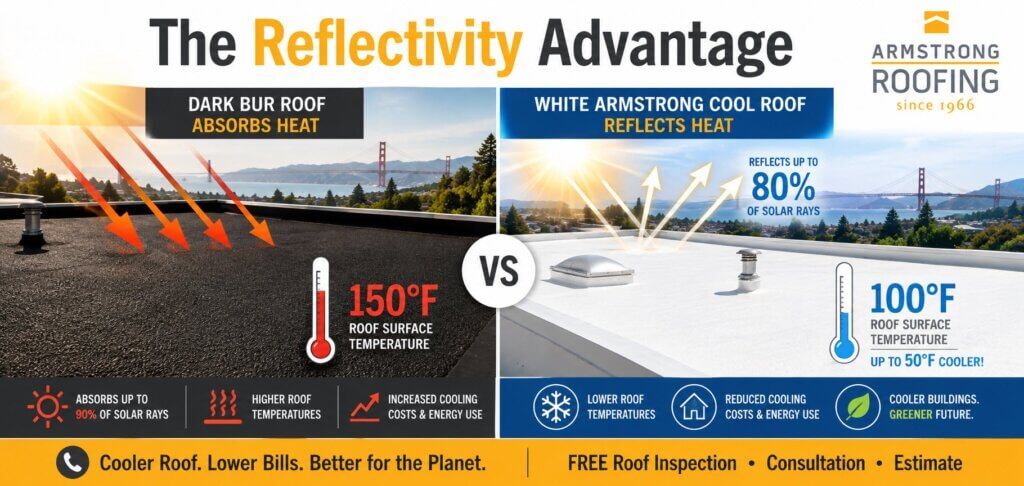
While the second UV layer is still wet, Armstrong technicians broadcast white ceramic granules into the finish. This creates a “cool roof” that reflects solar radiation rather than absorbing it. This can lower rooftop surface temperatures by 50°F to 80°F, significantly reducing the workload on your air conditioning and lowering cooling costs by up to 40%.
Specialized Applications in the Bay Area
Eichler Home Preservation
Palo Alto, San Rafael, and Walnut Creek are home to thousands of Eichler architectural gems. These homes are prized for their low-profile silhouettes and floor-to-ceiling glass. However, their original thin roof structures were often not designed to handle the heavy weight burden (600 lbs/sq) of tar and gravel. SPF is the ideal match for Eichlers because it preserves the minimalist aesthetic while adding 1/10th the weight of traditional materials.
Commercial and Industrial Resilience
For facilities like Camino Storage in Santa Clara or Cross Church in Napa, a leak is a threat to assets and reputation. Corrugated metal commercial roofs often suffer from fastener failure as the metal sheets move. Armstrong’s SPF creates a seamless bond that conforms to every ridge and valley of the metal, eliminating the fastener entry points for water entirely.
Solar Panels and Green Roofs
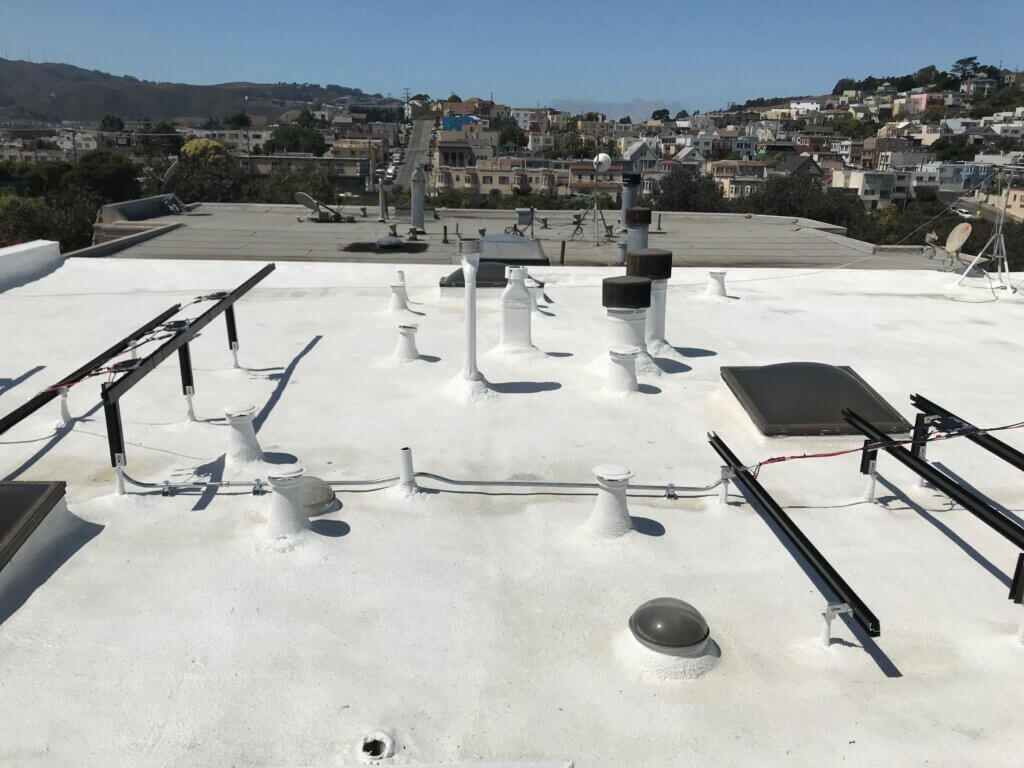
As Bay Area residents move toward renewable energy, many want to install solar arrays. SPF provides a robust, lightweight foundation for mounting brackets. Because the foam is self-flashing, it seals around solar mounts more effectively than traditional methods, preventing the “penetration leaks” common in panel installations.
Longevity and The Financial ROI of SPF
While the initial cost of a spray foam roof can be slightly higher than some budget BUR options, the long-term value is unsurpassed.
- Energy Payback: Research by Texas A&M University shows that energy savings typically pay for the entire cost of the roof installation within 3 to 4 years.
- Extended Lifespan: A BUR roof fails in 10-15 years, requiring another expensive replacement. An Armstrong foam roof is a lifetime system that only needs periodic recoating.
- Zero Tear-Off Costs: By applying SPF over an existing roof, property owners avoid the substantial labor and disposal fees associated with landfilling old materials.
40-Year Life Cycle Cost Analysis
| Expense Category | Built-Up Roof (BUR) | Armstrong SPF Roof |
| Initial Installation | Moderate | Moderate to High |
| Replacement Frequency | Every 10-15 Years | None (System is for life) |
| Maintenance | Frequent patches & cleaning | Minimal; bi-annual inspection |
| Recoating Cost | N/A (requires full tear-off) | ~25% of replacement cost |
| Energy Impact | High heat gain; dark surface | 40% Reduction in bills |
| Payback Period | None | 3 to 4 Years |
Maintaining Peak Performance
To ensure your flat roof never leaks again, Armstrong recommends a minimal but consistent maintenance routine:
- Bi-Annual Inspections: Check your roof in the spring and fall for debris or fallen branches.
- Clear the Drains: Ensure gutters and outlets are free of leaves so water can flow off the roof.
- Post-Service Checks: If HVAC technicians or solar installers have been on your roof, check for dropped tools that might have caused a localized puncture.
- Scheduled Recoating: Plan for a fresh AWS coating every 15-20 years to maintain UV integrity.

Frequently Asked Questions (FAQ)
Why do small flat roof leaks turn into major problems?
Small flat roof leaks allow water to migrate beneath the membrane into insulation and the roof deck, often unnoticed. Left unaddressed, this hidden moisture can spread, causing more extensive damage than the original defect suggested.
How quickly can hidden roof damage spread?
Spread speed depends on rainfall, roof design, drainage, and materials. Because mold-supporting conditions can develop within roughly 24 to 48 hours of sustained moisture, delays in leak remediation can allow damage to progress relatively fast.
Does a ceiling stain always mean I need a roof replacement?
No. A ceiling stain confirms water intrusion but not its extent. Repair, restoration, or replacement depends on membrane condition, deck integrity, and moisture spread. These are factors that only a professional roof inspection can accurately determine.
Can a flat roof leak be repaired without full replacement?
Often, yes. If the leak is isolated and the roof deck and insulation remain sound, targeted repair or restoration, such as recoating, may resolve the issue without requiring complete flat roof replacement.
When is roof restoration a better option than replacement?
Restoration is typically considered when the existing substrate and deck are structurally sound but the surface has aged or developed multiple minor defects, making recoating or an SPF overlay a reasonable path.
How do professionals locate hidden roof moisture?
Roofing contractors use methods such as infrared scanning, moisture meters, and, when justified, core sampling to identify saturated insulation or decking that isn’t visible from the roof surface or interior ceiling.
What affects the overall cost of flat roof leak repair?
Roof damage cost depends on leak size, how long moisture has been present, affected materials, roof accessibility, and whether interior reconstruction or mold remediation is required in addition to the roofing work itself.
How do commercial roof leaks differ from residential ones?
Commercial roof leaks often involve larger roof areas, more equipment penetrations, and business interruption risk. Residential flat roofs are typically smaller but may have less concealed space to buffer a leak before it’s visible.
Can foam roofing help prevent recurring flat roof leaks?
SPF roofing offers reduced seaming and close conformance to roof features, which may help reduce certain leak sources. It still requires a protective coating and periodic inspection to perform reliably over time.
What should I do after discovering a flat roof leak?
Avoid walking on unstable roof areas, note where interior stains appear, and schedule a professional roof inspection promptly. Early evaluation typically limits water intrusion and helps clarify the most cost-effective repair path.
Ready to Address a Flat Roof Leak Before It Spreads?
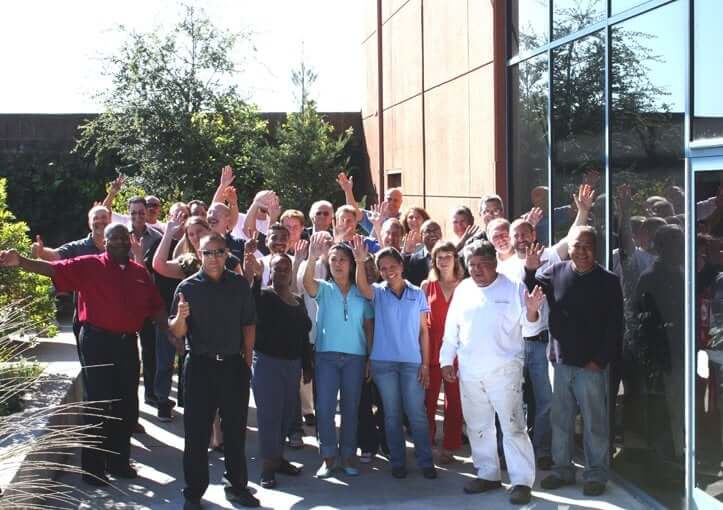
A small leak rarely stays small, but catching it early is usually far less disruptive and less costly than waiting until the damage becomes visible throughout the building. Armstrong Foam Roofing is a local family-owned and operated business that has been offering free consultations and estimates for residential and commercial property owners across the San Francisco Bay Area, including San Francisco, Oakland, Berkeley, San Jose, Palo Alto, Marin County, the Peninsula, and Silicon Valley since 1966.
If you’ve noticed a stain, a musty odor, ponding water, or a leak that keeps coming back, an honest evaluation of your roof’s actual condition is the most reliable next step. Early evaluation can help limit the extent of water intrusion and may help you avoid a more complicated repair down the road. Contact us today for your FREE Satellite Roof Estimate, remote consultation, or at-home (outside) estimate. Call (855) 777-1234 or fill out our online contact form to schedule your no-obligation inspection!