

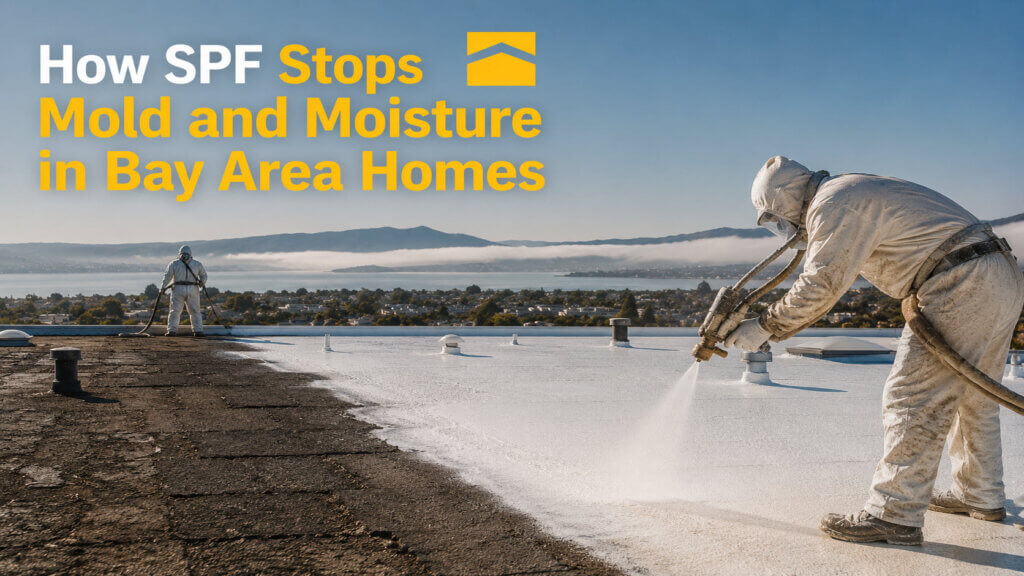
If you’ve ever pulled up a corner of old roofing felt in the East Bay or Peninsula and caught that unmistakable musty smell, you already know something most homeowners learn the hard way: a flat roof doesn’t have to leak to cause a mold problem. It just has to stay damp long enough.
That’s the quiet threat coastal California roofs live with every single day. Fog rolls in off the Bay most mornings, temperatures swing ten or fifteen degrees between noon and midnight, and older tar and gravel systems were never built to shed that kind of relentless moisture cycling. After a decade or two, the seams open up, the felt layers separate, and water finds its way into the insulation, where it just sits.
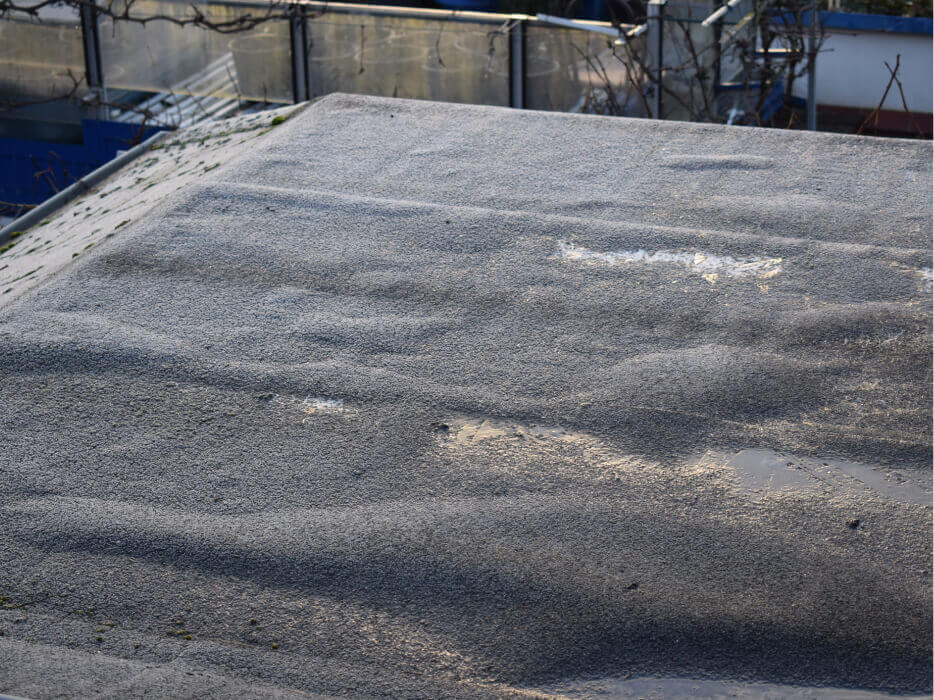
This is where spray foam roof replacement changes the equation. A properly installed spray polyurethane foam (SPF) system doesn’t just patch over the problem, it eliminates the seams, laps, and fasteners that let moisture in to begin with, and it does it in a single seamless membrane. For homeowners, HOA boards, and property managers dealing with an aging flat roof anywhere from San Francisco to San Jose, understanding why that matters is the difference between a roof that lasts five more years and one that lasts fifty or even a lifetime.
What Causes Mold and Moisture Problems in Coastal Homes?
Mold needs three things to grow: a food source (which any roof deck, insulation board, or wood framing provides), a comfortable temperature range, and moisture. In most homes, you can’t control the first two. You can absolutely control the third, and that’s exactly where coastal construction runs into trouble.
The Bay Area’s marine layer keeps relative humidity elevated for large stretches of the year, particularly close to the water in San Francisco, Marin, and the Peninsula. When warm, moist indoor air meets a cold roof deck overnight, condensation forms on the underside of the roofing assembly, even without a single drop of rain. Add in:
- Aging insulation that has already absorbed moisture and lost most of its R-value
- Roof leaks at seams, flashing, and penetrations that let water in directly
- Poor attic or roof-deck ventilation, which traps humid air against wood framing
- Decades-old roofing systems that were never designed for a 40-, 50-, or 60-year service life
and you have a building envelope that’s fighting a losing battle. By the time a stain shows up on a ceiling, the moisture has usually been working on the roof deck and insulation for months, sometimes years. According to the U.S. Environmental Protection Agency, mold is rarely a problem indoors unless there is excess moisture feeding it, which is why controlling moisture at the source, rather than treating mold after the fact, is the only real long-term fix.
Why Traditional Tar and Gravel Roofs Become Moisture Traps
Tar and gravel, technically a built-up roof (BUR), has been used on Bay Area flat roofs for close to a century, and it’s easy to see why it stuck around: it’s familiar, and contractors have installed it for generations. But the same layered construction that made it popular is exactly what turns it into a moisture trap as it ages.
A BUR system is built from multiple plies of asphalt-saturated felt, glued together and topped with a gravel ballast. Every one of those seams is a potential failure point. As the asphalt dries out and becomes brittle from decades of UV exposure and thermal cycling, the seams crack, the felt layers separate, and the flat (or nearly flat) slope means water doesn’t run off, it ponds. Ponding water finds the smallest crack and works its way down into the insulation board below.
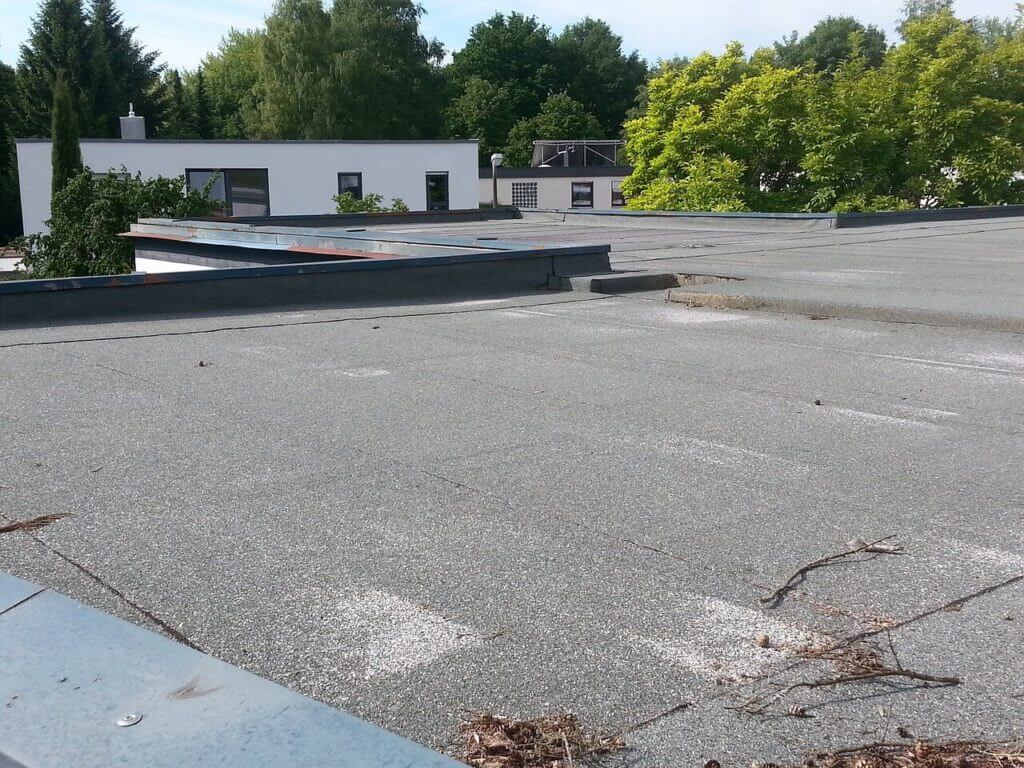
Here’s the part most homeowners don’t realize until a re-roof is already underway: once water gets into that insulation layer, gravel and felt hide the damage almost completely. You can have a saturated, mold-growing roof deck for years with no visible sign inside the building, because the leak isn’t dripping, it’s just sitting there, soaking the substrate and slowly rotting the wood below. That’s typically why Bay Area roofers report that tar and gravel roofs need full replacement roughly every 12 to 15 years, far short of what a modern spray foam system delivers.
Signs Your Flat Roof Should Be Replaced & Advanced Solutions
| Problem | Cause | Potential Damage | Recommended Solution |
| Ponding water 48+ hours after rain | Inadequate slope, aging membrane | Accelerated leaks, structural stress | SPF application with slope correction |
| Cracked or alligatored surface | UV exposure, asphalt aging | Water infiltration through cracks | Full spray foam roof replacement |
| Musty odor indoors | Trapped moisture in insulation | Mold growth, poor indoor air quality | Moisture survey and SPF replacement |
| Bubbling or blistering | Trapped moisture beneath layers | Membrane failure, hidden rot | Tear-off of saturated areas, SPF recoat |
| Rising energy bills | Poor or degraded insulation | Ongoing added HVAC cost | SPF roofing with reflective topcoat |
| Visible seam separation | Aging adhesives, thermal cycling | Direct leak paths | Seamless SPF membrane |
* For custom diagnoses, technical thermal mappings, or physical core-sample evaluations, contact an Armstrong Foam Roofing specialist.
How Spray Polyurethane Foam Roofing Prevents Moisture Problems
Spray polyurethane foam roofing works on a completely different principle than layered roofing systems. Two liquid chemicals, a polyol resin and an isocyanate, are mixed and sprayed directly onto the roof deck or existing roof surface. Within seconds, the mixture expands to many times its original volume and cures into a solid, closed-cell foam that’s fully adhered to whatever is underneath it.
This seamless installation is the primary reason SPF roofing excels at moisture protection.
- No Exposed Joints: Because it is a monolithic layer, there are no seams to separate, crack, or pull apart during the Bay Area’s temperature shifts.
- Waterproof Barrier: Armstrong Foam Roofing uses high-density 3LB closed-cell foam. The cells in this foam are so tightly packed that moisture simply cannot penetrate them.
- Superior Adhesion: The liquid foam forms a tenacious bond with the roof substrate, conforming to every ridge and valley to eliminate gaps where water could hide.
- Self-Flashing Technology: SPF effectively seals around complex roof features like skylights, vents, and parapet walls without the need for metal flashing, which is a common site for leaks.

The closed-cell structure is the other half of the story. Unlike open-cell foam or fibrous insulation, closed-cell SPF doesn’t absorb water. Each individual cell is sealed, so even if water sits on the surface, it can’t wick into the material and saturate it the way it saturates felt or fiberglass insulation. Combined with superior adhesion to the substrate, that gives you a roof that’s functioning as a waterproof barrier and an insulation layer at the same time, something no other flat roofing system can claim in a single application.
Why Closed-Cell SPF Helps Prevent Mold Growth
The mold-prevention case for SPF really comes down to eliminating the two conditions mold needs on a roof deck: trapped moisture and temperature swings that drive condensation.
Because the foam is fully adhered and seamless, there’s no cavity between the roofing material and the deck where moist air can circulate and condense, the way there often is under a mechanically fastened membrane. And because closed-cell foam carries a high R-value, roughly R-6.5 per inch, it also acts as a thermal break that keeps the roof deck’s interior surface closer to indoor temperature, which reduces the condensation risk that comes from a cold deck meeting warm, humid air.
The practical result: fewer hidden leaks, a roof deck that stays dry, and a building envelope that isn’t quietly feeding mold growth behind the scenes. That matters beyond just roof longevity. The California Department of Public Health has noted that visible water damage, damp materials, or mold odor in a building point to a real, measurable increase in respiratory health risk for occupants, which is one more reason moisture control at the roof deck isn’t just a maintenance issue, it’s an indoor air quality issue.
To Summarize
SPF roofing addresses the root causes of biological growth in several ways:
- Moisture Resistance: By providing an impenetrable barrier, SPF prevents the water infiltration that leads to mold in your ceiling and drywall.
- Reduced Condensation: SPF provides superior insulation, which helps keep the roof surface temperature consistent. This prevents the “dew point” from occurring inside your building envelope, significantly reducing interior condensation.
- Improved Air Quality: By sealing air leaks, SPF prevents outdoor pollutants and allergens from entering your home through the roof, resulting in a healthier indoor environment.
- Long-Term Durability: SPF does not pack down or sag over time, ensuring that its moisture-resistant properties remain intact for decades.
Energy Savings From SPF Roofing
Moisture control gets most of the attention, but the insulation performance is what makes SPF pay for itself. SPF is recognized by the U.S. Department of Energy as one of the most efficient roofing materials available.
- High R-Value: Armstrong’s SPF has an aged R-value of 6.2 – 6.5 per inch, providing more thermal resistance than almost any other material.
- Reduced HVAC Costs: The combination of insulation and air sealing allows SPF to be over 500% more efficient than conventional roofs. This typically reduces heating and cooling bills by up to 40%.
- Temperature Stability: SPF creates a “Cool Roof” when finished with reflective white coatings, keeping rooftop temperatures up to 100°F cooler in the summer.
- Sustainability: Because it can often be applied over existing roofs, it reduces landfill waste and the building’s overall carbon footprint.
The U.S. Department of Energy has found that resurfacing a roof with a reflective coating, which is exactly what tops off an SPF system, can reduce a commercial building’s annual air conditioning energy use by as much as 25%. Additionally, Lawrence Berkeley National Laboratory’s Heat Island Group has measured that a clean, reflective white roof can run about 50 degrees Fahrenheit cooler than a dark gray roof on a typical summer afternoon. For Bay Area buildings, where interior temperature swings between fog-cooled mornings and sun-heated afternoons are common, that stability shows up directly in lower HVAC cycling and a more comfortable interior.
Why SPF Roofing Is Ideal for Eichler Homes
Eichler homes present a specific challenge that most roofing systems weren’t designed to solve: a low-slope or flat roof that’s structurally and architecturally central to the house, not something you can just cap with a bulky new system without changing the look of the home.
The original tar and gravel roofs on most Eichlers offered almost no insulation, which is why so many of these homes run hot in summer and cost a fortune to heat in winter. They’re also heavy. A built-up roof can weigh around 600 pounds per 100 square feet, a real concern on post-and-beam construction that was never engineered to carry much extra load. Spray foam, by comparison, weighs roughly 60 pounds per 100 square feet, reducing the stress on the same walls and beams by 90%.

Because SPF is sprayed rather than layered, it conforms to the exact roofline of the home without altering its silhouette, preserving the clean geometry that makes an Eichler an Eichler. Moreover, spray foam roofing allows for custom-contoured drainage because during installation, technicians use the foam to build up low areas, creating a positive slope that guides water toward drains and eliminates “birdbaths.” It also frequently allows for foam application directly over the existing roof structure, meaning less tear-off, less disruption, and a faster project timeline, while still delivering the seamless waterproofing and added insulation these homes have needed since the day they were built.
Replacing an Old Tar and Gravel Roof With SPF Roofing
A well-run SPF roof replacement follows a fairly predictable sequence, though the details shift depending on the condition of what’s underneath:
- Inspection and moisture survey. A qualified contractor checks for saturated insulation, structural issues, and areas that need repair before anything gets sprayed.
- Substrate preparation. The roof is cleaned, dried, and repaired. Any insulation that’s already wet typically needs to come out, since SPF won’t adhere properly over damp material.
- Foam application. Technicians spray the closed-cell foam in a controlled thickness, often building in slope where drainage has been a problem, since foam can correct ponding issues that a flat membrane simply can’t.
- Protective coating. A UV-resistant silicone or elastomeric topcoat goes on to protect the foam from sun exposure and give the roof its reflective, energy-saving surface.
- Granule broadcast (optional). A layer of ceramic granules can be added into the wet topcoat for extra traction and durability underfoot.
Done correctly, a system like this is rated for a 50-year service life and with proper maintenance, it can last a lifetime. Proper maintenance is basically periodic recoating (typically every 15 to 20 years) rather than a full tear-off, which is a fundamentally different maintenance model than the “replace it every 12 to 15 years” cycle that tar and gravel demands.
Traditional Flat Roof vs. Spray Polyurethane Foam (SPF) Roofing
| Feature | Tar & Gravel / BUR | Spray Foam (SPF) |
| Waterproofing | Multiple seamed layers | Fully seamless, monolithic membrane |
| Seams/Joints | Many, all potential leak points | None |
| Insulation | Minimal to none built-in | Built-in, roughly R-6.5 per inch |
| Typical Lifespan | 12–15 years before full replacement | 50+ years to a lifetime with periodic recoating |
| Maintenance | Frequent inspection and patching | Recoat every 15–20 years |
| Energy Efficiency | Low; dark surface absorbs heat | High; reflective, insulating |
| Leak Resistance | Vulnerable at seams and flashing | Self-flashing, no seams to fail |
| Mold Prevention | Poor; hides trapped moisture | Strong; closed-cell resists water absorption |
* Based on standard performance data comparing traditional Built-Up Roofing (BUR) and advanced Spray Polyurethane Foam (SPF) installations
Why Armstrong Foam Roofing Is the Best Choice in the Bay Area
Armstrong Foam Roofing has been a family-owned business serving the San Francisco Bay Area since 1966, and for more than four decades of that history, SPF roofing has been the company’s specialty. That’s not a marketing line; it’s reflected in the numbers: Armstrong has installed foam roofing on more residential properties than any other company in the country, backed by over 30,000 satisfied Bay Area customers across residential and commercial projects.
That kind of track record matters with SPF specifically, because this isn’t a system where “close enough” installation holds up. Spray foam roofing requires precise mixing ratios, controlled application thickness, and correct timing on the topcoat, and a contractor who cuts corners on any of those steps can turn a 50-year roof into a five-year headache. Armstrong’s crews work to standards recognized by the Spray Polyurethane Foam Alliance (SPFA) and the National Roofing Contractors Association (NRCA), and the company’s decades of hands-on experience with Bay Area microclimates, from the fog belt in San Francisco and Marin to the hotter interior valleys around the South Bay, means the recommendations you get are based on what actually performs here, not a generic national playbook. What’s more, we use only high-quality 3LB closed-cell foam and provide some of the longest-lasting warranties in the industry.
Armstrong also brings specific, well-earned expertise with Eichler and mid-century modern homes, a niche that requires a genuinely different approach than a standard commercial flat roof, along with a full range of commercial, industrial, and residential foam roofing services across San Francisco, Oakland, Berkeley, Palo Alto, San Jose, and the wider East Bay, South Bay, and North Bay. Whether you’re managing a single Eichler in Palo Alto or a multi-building commercial property in Oakland, that combination of specialization and scale is hard to match.
Frequently Asked Questions
Is SPF roofing waterproof?
Yes. Closed-cell spray polyurethane foam, topped with a silicone or elastomeric coating, forms a seamless, fully adhered membrane with no laps or fasteners for water to penetrate, making it one of the most waterproof flat roofing systems available.
Can SPF roofing stop mold?
SPF roofing addresses the root cause of most roof-related mold problems by eliminating hidden leak paths and resisting water absorption in the insulation layer itself. It won’t fix an existing mold problem inside a building, but it removes the ongoing moisture source that lets mold keep growing.
Does spray foam roofing work in coastal climates?
Yes. The seamless, closed-cell design is particularly well suited to foggy, humid coastal conditions because it doesn’t rely on seams or laps that can degrade under constant moisture exposure and temperature swings.
How long does SPF roofing last?
A properly installed and maintained SPF roof is commonly rated for a 50-year service life but it can last a lifetime, with recoating recommended roughly every 15 to 20 years rather than a full tear-off and replacement.
Can SPF roofing be installed over an old tar and gravel roof?
Often, yes, as long as the existing insulation isn’t already saturated. If moisture is present, that area needs to be dried out or removed before foam is applied, which is why a moisture survey is a standard first step.
Is SPF roofing energy efficient?
Yes. With an R-value of roughly 6.5 per inch and a reflective topcoat, SPF roofing systems can meaningfully reduce cooling costs, and federal data shows reflective roof coatings can cut a commercial building’s annual air conditioning energy use by up to 25%.
Is SPF good for Eichler homes?
It’s widely considered the leading option for Eichlers specifically because it’s lightweight, conforms to the home’s original flat roofline without altering its appearance, and solves the insulation and drainage problems that plague the original tar and gravel roofs.
Does SPF require maintenance?
Yes, but far less than traditional systems. Twice-yearly visual inspections and a scheduled recoating every 15 to 20 years is typically all that’s needed to keep the system performing for decades.
Is SPF roofing environmentally friendly?
SPF roofing can often be applied directly over an existing roof, avoiding the landfill waste of a full tear-off, and its energy efficiency reduces a building’s ongoing carbon footprint through lower HVAC demand.
How much does spray foam roofing cost?
Pricing varies by market and roof condition, but SPF roofing is commonly priced in the range of several dollars per square foot installed. Because it lasts significantly longer than tar and gravel or modified bitumen and requires only periodic recoating rather than full replacement, most owners see it pay back the higher upfront cost over the life of the roof. A site-specific estimate is the only reliable way to know your actual cost.
The Bottom Line on Moisture, Mold, and Your Roof
Coastal moisture isn’t going away, and neither is the aging tar and gravel roof sitting on top of your home or building. Every foggy morning and every winter storm is one more cycle of expansion, contraction, and quiet water intrusion working against a roofing system that was likely never designed to last this long in the first place.
Spray foam roof replacement solves the actual problem, not just the symptom. A seamless, closed-cell membrane removes the leak paths that let moisture in, adds serious insulation value that lowers your energy bills, and gives you a roof rated for 50 years instead of 12 to 15. Whether you’re protecting an Eichler’s mid-century roofline, managing a commercial property with a ponding-water problem, or just tired of patching the same leak every winter, the math favors doing it right once.
Comprehensive Benefits of SPF Roofing Systems
| Benefit | Homeowners | Commercial Buildings |
| Seamless waterproofing | Fewer leaks, less anxiety during storm season | Reduced liability from interior water damage |
| High R-value insulation | Lower heating and cooling bills | Reduced HVAC load across large roof areas |
| Lightweight application | Safe for older, post-and-beam homes like Eichlers | Minimal added structural load |
| Long service life | Fewer full replacements over time | Lower lifecycle roofing cost |
| Renewable recoat system | Predictable, budget-friendly maintenance | Easier capital planning for facility managers |
| Mold and moisture resistance | Healthier indoor air for the family | Better tenant satisfaction and retention |
* Spray Polyurethane Foam (SPF) systems deliver structural protection and thermal optimization tailored to both residential engineering and industrial application scales
Armstrong Foam Roofing has been solving exactly this problem for Bay Area homes and businesses since 1966. If your flat roof is showing its age, don’t wait for the ceiling stain to tell you what the insulation already knows. Contact Armstrong Foam Roofing today for a free inspection and estimate, and find out whether spray foam roof replacement is the right long-term fix for your Eichler home, commercial flat roof, or aging tar and gravel system.